School Flooring Installation on Maui
Maui Prestige Flooring installs school flooring for public and private K-12 schools, preschools and college buildings across Maui. Across 1,700+ flooring jobs in 16+ years, we have found that school work is judged on two things: being done before the first bell and leaving clean air behind.
Classrooms, cafeterias, corridors and gyms each need a different floor and a different cleaning plan. We help facilities staff, administrators and general contractors pick floors their custodians can realistically keep up with.
Every school job is scheduled around the academic calendar, built with low-VOC products and backed by the documents public projects require.
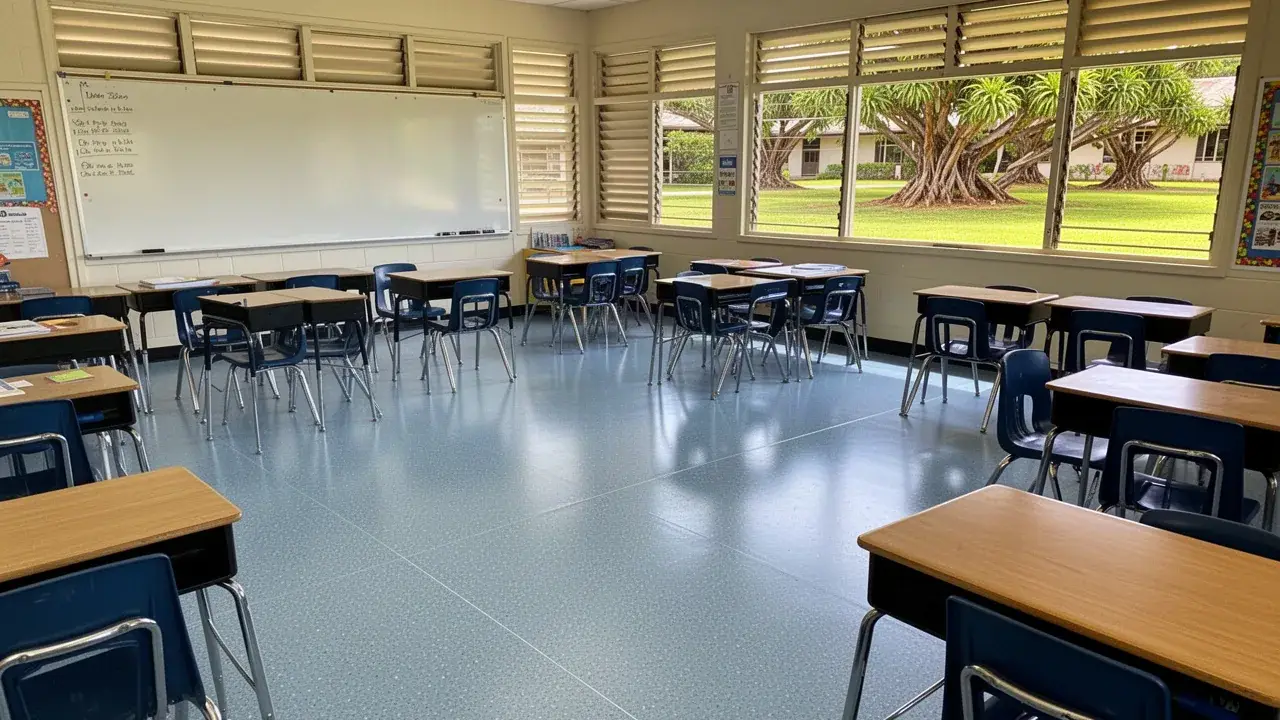
School and Education Flooring Installation
School flooring installation covers every floor on a campus, from kindergarten classrooms to the gym. We remove the old floor, deal with what is underneath, install the new one and hand the rooms back clean and ready for furniture.
We work for public and private K-12 schools, charter schools, preschools and early learning centers, college and training buildings, and the general contractors who build and renovate them.
A typical school scope includes:
- Moving and stacking classroom furniture, then resetting it
- Removing carpet, VCT or sheet goods once testing clears it
- Slab moisture testing, patching and leveling
- Installing VCT, sheet vinyl, LVT, carpet tile, rubber or sports flooring
- Rubber cove base, stair treads and accessible transitions at every door
- Initial floor finish on VCT and a care guide for custodial staff
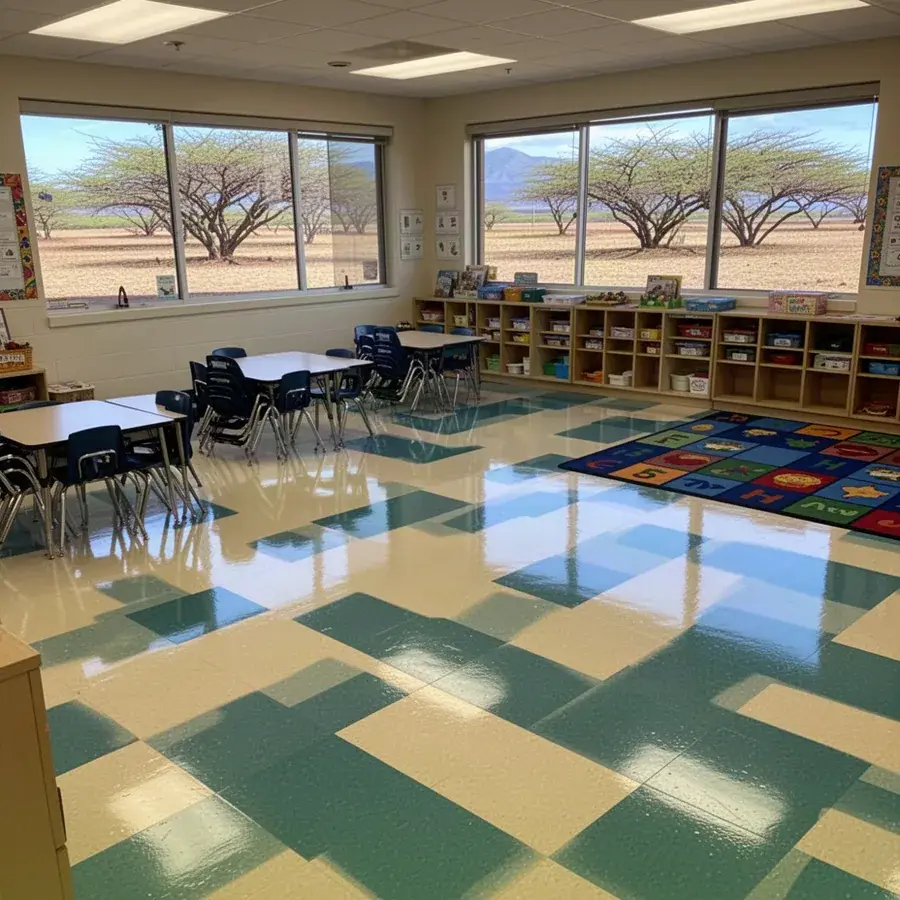
Flooring for Classrooms, Gyms, Cafeterias and Halls
Each part of a school takes a different kind of abuse, so each gets its own floor. This is where we usually land, and why.
| Space | Recommended floor | Why |
|---|---|---|
| Classrooms | VCT, commercial LVT or sheet vinyl | Survives chair legs and spills; carpet tile only in reading corners |
| Preschool rooms | Cushioned sheet vinyl or LVT, carpet tile for circle time | Softer for falls, sealed seams for messes |
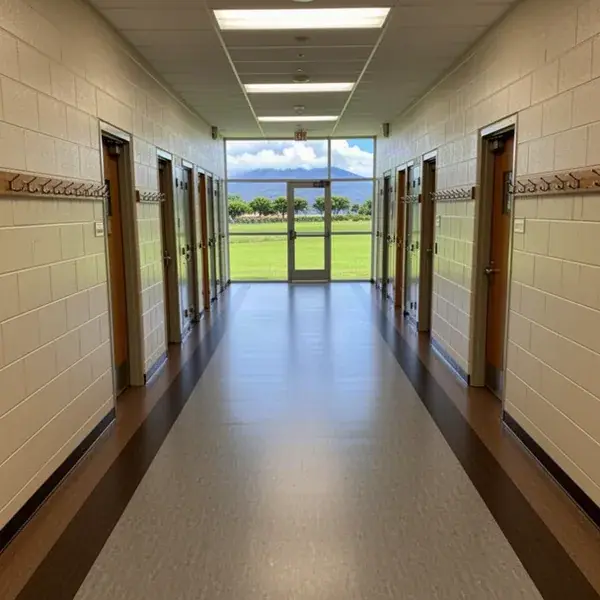
| Corridors | VCT or sheet vinyl, existing terrazzo restored where present | Takes the heaviest traffic and machine cleaning |
| Cafeterias | Sheet vinyl or VCT; quarry tile or urethane cement in the kitchen | Food spills, table drags and wet mopping |
| Gyms | Maple sports floor or poured urethane on courts, rubber in weight rooms | Shock absorption, ball bounce, dropped weights |
| Libraries and offices | Carpet tile | Quiet, warm, easy single-tile repairs |
| Science labs and art rooms | Chemical-resistant sheet vinyl or epoxy | Resists stains, paint and spilled chemicals |
| Restrooms | Sheet vinyl with integral cove, or epoxy | Seamless, sanitary and easy to hose down |
VCT has been the school standard for decades because it is cheap to install and easy to patch. Many schools now choose no-wax LVT or sheet vinyl instead, trading a higher install price for years of saved stripping and waxing labor.
Maui campuses add local wear. Red dirt from Central Maui playfields and sand near the coast grind down floor finish at every outside door, so we specify walk-off carpet tile at entries and a heavier wear layer in classrooms that open straight onto an outdoor walkway. Many island schools use covered exterior walkways instead of enclosed halls, so every classroom door is an entry.
Product details are on our sheet vinyl and VCT installation page. Gym projects follow our gym and sports flooring installation process, and weight rooms use the systems on our rubber flooring installation page.
Summer and Break Scheduling
Summer is the main window for school flooring on Maui. Hawaii public schools typically end in late May and return in early August, which leaves roughly nine to ten weeks, and teachers often want rooms back a week before students arrive.
Shorter breaks still help with small scopes:
- Fall break, usually about a week in early October
- Winter break, about two to three weeks at the end of December
- Spring break, about a week in March
Large summer jobs are planned backward from the first teacher workday. Testing, bidding and material ordering happen in winter and spring, because special-order flooring can take 4 to 6 weeks to ship to the island and mainland freight gets busy before the school year.
Survey and test
Winter
We walk the rooms, take slab moisture readings and confirm asbestos status for any flooring that will be disturbed.
Bid and order
Spring
The bid is priced, approved and product is ordered to land on Maui before the last day of school.
Remove and install
June and July
Rooms are worked in a sequence agreed with facilities, so custodians can deep clean finished wings behind us.
Cure and hand back
Before teachers return
Adhesives cure, VCT gets its finish coats and furniture goes back with time to spare.
Campuses in Central Maui are closest to our base, listed on the Kahului and Wailuku service area page. Upcountry, Hana-side and Lanai or Molokai schools are scheduled in blocks so travel and barge freight fit the same break.
Want new floors ready for the first day of school?
Start the conversation in winter and we will build your summer schedule around it.
Low-VOC Materials and Indoor Air
Low-VOC flooring keeps the solvents and odors that new floors can release out of classroom air. We choose certified products, use low-emitting adhesives and leave enough cure time that students come back to rooms that smell clean, not new.
Certified flooring
Resilient floors carry FloorScore certification and carpet tile carries CRI Green Label Plus. Both test emissions against the California CDPH standard method that many school specs reference.
Low-emitting adhesives
We use solvent-free, water-based or pressure-sensitive adhesives with Green Label Plus or similar certification. Fewer fumes for the crew and for the next class.
Cure and air-out
Adhesives get 48 to 72 hours with air handling running before furniture returns. VCT finish coats go on early so the last coat is dry well before students arrive.
Slab moisture affects air quality too. Moisture and high pH rising through concrete can break down flooring adhesive and cause a lingering odor, which is why we test before glue-down sheet goods and add a moisture vapor barrier system where readings call for it.
Public School Bids and Prevailing Wage
Public school flooring in Hawaii is bought through the state procurement system, and the paperwork matters as much as the price. Most projects are solicited under the Hawaii Public Procurement Code (HRS Chapter 103D), either directly or through a general contractor.
Public works construction over $2,000 also falls under Hawaii’s prevailing wage law, HRS Chapter 104. That means paying the published wage rates for each trade and submitting certified payroll every week. State contracts also ask for a current Hawaii Compliance Express certificate showing tax, labor and business registration standing.
Private and charter schools set their own rules, though projects with public funding can still carry wage requirements. Federal funding brings Davis-Bacon into play, which our government and military flooring page explains alongside certified payroll. For how school projects fit into our wider commercial work, see our commercial flooring contractor overview.
FAQ
School Flooring FAQ
Can flooring be finished over a short school break?
Small scopes can. One to three classrooms of carpet tile or LVT over a sound slab usually fit a one-week fall or spring break, including removal of flooring that has already tested negative for asbestos.
Building-wide work, abatement, slab leveling and anything with long cure times belongs in the summer window.
What flooring is easiest for custodial staff to maintain?
No-wax floors save the most custodial labor: commercial LVT, heat-welded sheet vinyl and rubber need only a neutral cleaner and an auto-scrubber. VCT costs less to install but needs a strip, seal and wax program, typically once or twice a year with regular burnishing in between. Carpet tile needs daily vacuuming and periodic extraction, but a damaged tile swaps out in minutes.
Do you remove old VCT in older school buildings?
Yes, after testing. Under the federal AHERA rule, K-12 schools keep an asbestos management plan, and 9 x 9 inch tile and black mastic in older buildings must be sampled by an accredited inspector or treated as asbestos-containing.
If it tests positive, a licensed abatement contractor removes it under Hawaii Department of Health rules before we prep and install. Our floor removal and disposal page explains the process.
Where we install school flooring in Maui County
Get a quote
Talk to Us About Your School Project
Send the rooms, the floor plan or the bid documents and the break you are aiming for. We will walk the campus and send a school flooring bid with a schedule that fits your calendar.
- Mon to Sat 7am to 9pm, Sun 9am to 9pm
- 1710 W Kaahumanu Ave, Wailuku, HI 96793
- Licensed, insured and backed by a 1-year labor warranty