Solid Hardwood Flooring Installation on Maui
Maui Prestige Flooring installs solid hardwood floors in raised-floor homes across Maui, from plantation cottages in Paia to newer wood-framed builds in Kula. Across 16+ years and more than 1,700 flooring jobs, we have learned exactly what solid wood needs to stay flat in island humidity.
Solid hardwood is the floor you refinish for your grandchildren. It is also the least forgiving of shortcuts, so we only recommend it where the subfloor, the climate control and the species give it a fair chance.
We handle the whole job: subfloor checks, moisture readings, acclimation, nail-down installation, optional site finishing and trim. The work is backed by our 1-year labor warranty and the wood maker's product warranty.
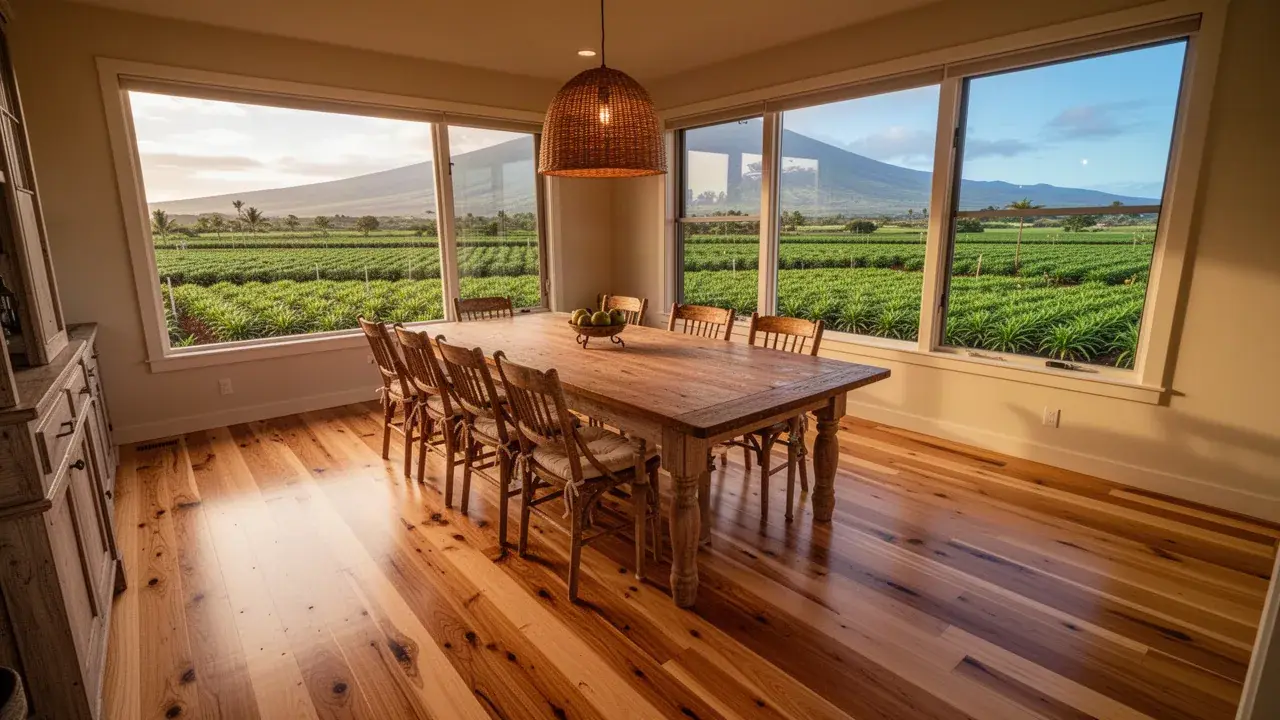
What Our Solid Hardwood Installation Includes
Solid hardwood is a single piece of milled wood, usually 3/4 inch thick, with a tongue and groove along its edges. Because it is wood all the way through, it can be sanded back to fresh timber again and again over a life that often passes 50 years.
It suits owners of raised-floor homes who plan to stay put, and anyone who wants a stain color mixed and tested in their own room. Every solid hardwood flooring installation we quote includes:
- Furniture moving and removal of the old floor
- Inspection of joists and plywood for rot, soft spots and termite signs
- Moisture readings on the boards and across the subfloor
- Acclimation in your home until those readings line up
- Asphalt-laminated paper underlayment, then nail-down installation
- Optional sanding, staining and finishing on site
- Baseboards or quarter round, transitions and cleanup
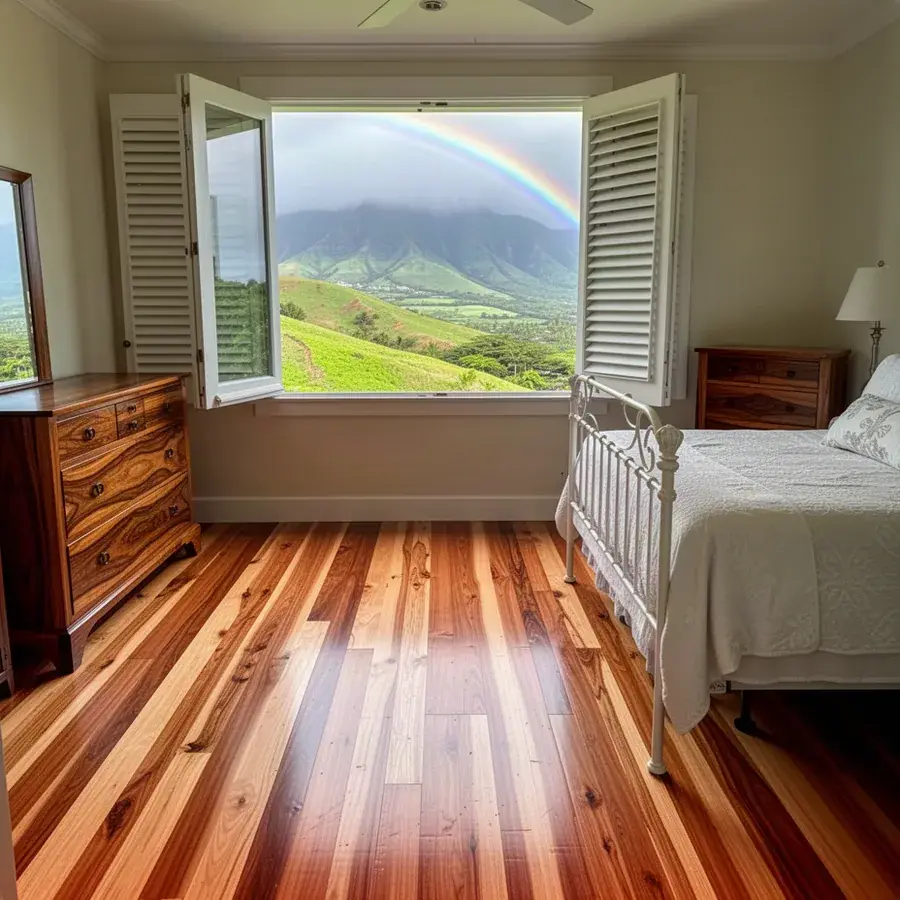
Is Solid Hardwood Right for Your Maui Home?
Solid hardwood is the right call if your home has a raised, wood-framed floor with a sound plywood subfloor and you can keep indoor humidity reasonably steady. If your floor is a concrete slab, it almost never is, and we will say so at the measure.
Raised Floors With Plywood Subfloors
This is where solid wood shines. Many older homes in Wailuku’s town core, Makawao, Kula and the plantation camps around Paia sit on post-and-pier foundations with a crawlspace below, and homes in Upcountry Maui are often built this way.
We want 3/4 inch plywood (5/8 inch at minimum) over joists, screwed down tight with no soft spots. We also check that the crawlspace has a 6 mil polyethylene ground cover and decent airflow, so soil moisture does not rise into the new boards.
Concrete Slabs: When Engineered Wood Is the Safer Call
Most Maui homes and nearly every condo sit on concrete, and solid wood should not be fastened straight to a slab here. Ground moisture wicks up through slabs poured without a vapor retarder, and a 3/4 inch board answers by cupping.
Engineered hardwood installation gives you the same real wood surface with a cross-ply core built for concrete. A plywood sleeper system over the slab can carry solid wood, but it raises the floor about 1 1/2 inches and rarely makes sense once door and cabinet heights are counted.
Species, Widths and Finish Options
Solid hardwood offers more choices than any other floor: species, grade, board width, and whether the finish is applied in a factory or in your living room. Here is how we help clients narrow it down.
Prefinished vs Site-Finished Boards
Prefinished boards arrive with a factory-cured aluminum oxide urethane finish and small beveled edges, so the room is usable as soon as the trim is on. Site-finished boards go down raw, then are sanded flat, stained to your approved sample and coated with several layers of polyurethane, such as Bona’s water-based finishes.
The table below compares the two side by side.
White Oak, Acacia and Dense Tropical Hardwoods
- White oak: the most versatile choice, takes stain evenly, and rift or quartersawn boards move noticeably less than plainsawn. Mid price.
- Acacia: bold color swings from blond to chocolate and harder than oak. Budget to mid price.
- Teak: naturally oily and very stable in humidity, though softer. Premium price.
- Cumaru, tigerwood and merbau: very dense, needing pre-drilled face nails at walls and a heavier nailer. Mid to premium price.
| Factor | Prefinished | Site-finished |
|---|---|---|
| Install time, about 1,000 sq ft | 3 to 5 days | Add 3 to 5 days for sanding and coats |
| Dust | Cutting dust only | Sanding dust, controlled with dust extraction |
| Finish durability | Very hard factory finish | Strong and renewable with a screen and recoat |
| Custom stain | Limited to the maker’s colors | Any color, tested on your boards |
| Surface | Small bevels between boards | Flat and seamless, easy to mop |
| Move out needed | No | Usually 2 to 4 days while coats cure |
Widths run from 2 1/4 inch strip to 5 inch plank, and the hardness of each species is compared on our hardwood flooring page for Maui homes. We generally cap solid boards at 5 inches here and add glue-assist, a bead of urethane adhesive under each row, on wider planks to resist cupping.
Acclimation and Moisture Control in Maui Humidity
How long to acclimate hardwood flooring on Maui? Usually 3 to 10 days, but the real finish line is a moisture reading, not a date. Coastal Maui averages roughly 70 to 80 percent relative humidity, and boards must reach balance with your indoor air before they are nailed.
Mainland mills typically kiln-dry flooring to around 6 to 9 percent moisture content, which suits a drier climate than most Maui homes. We open the cartons, stack the bundles with spacers so air reaches every board, and log readings with a pin-type moisture meter.
Following National Wood Flooring Association guidelines, strip boards under 3 inches wide should read within 4 percent of the subfloor, and planks 3 inches or wider within 2 percent. Until both match, the floor waits.
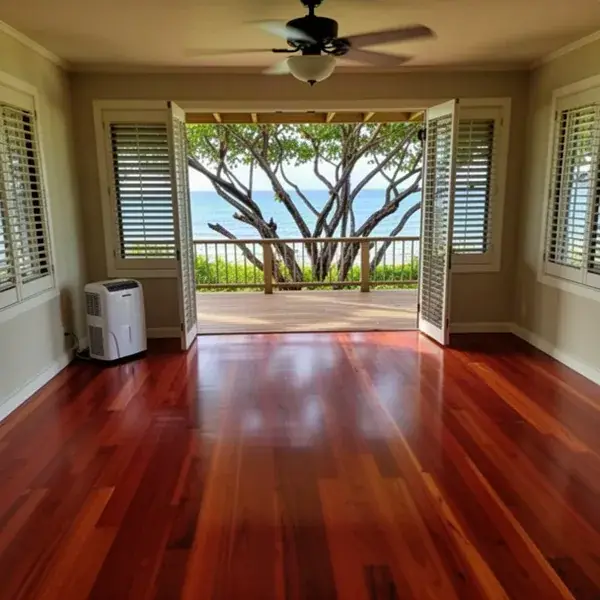
You can speed things up before the wood arrives:
- Run air conditioning or a dehumidifier at normal living settings for at least 5 days
- Finish drywall, paint and tile work first, since they release moisture
- Keep lanai sliders and windows closed while the boards adjust
We leave a 3/4 inch expansion gap at every wall, hidden under baseboard or quarter round, so the floor can swell through a rainy winter without buckling. In damp crawlspaces, a moisture vapor barrier below the floor framing is worth discussing too.
Have a raised floor and dreaming of real oak?
We will check your joists, plywood and moisture levels and tell you honestly if solid wood is the right fit.
How We Install a Solid Hardwood Floor
Measure and moisture readings
One visit
We measure every room, read the subfloor moisture in several spots and check door and cabinet heights. Bring your species shortlist and we will compare samples in your own light.
Delivery and acclimation
3 to 10 days
Boards are delivered to the rooms where they will live, opened and stacked with spacers. We return to take readings until wood and subfloor match.
Subfloor prep and underlayment
Half a day to 1 day
Loose plywood is screwed down, humps are planed and seams are flattened. We roll out Fortifiber Aquabar B or a similar asphalt-laminated paper, overlapped at the seams.
Racking and nail-down
1 to 3 days
Boards from several cartons are racked out to blend color and stagger end joints by at least 6 inches. Each board is blind-nailed with 2 inch cleats every 6 to 8 inches and near each end.
Sand and finish
3 to 5 days, site-finished only
Raw floors are sanded flat through progressively finer grits, stained to your sample and given three coats of finish. Prefinished floors skip this step.
Trim and walkthrough
Final day
Baseboards or quarter round go on, transitions are fitted and the floor is cleaned. We walk it with you and leave care instructions and spare boards.
Carrying the same wood up the stairs? Our stair, tread and railing installation matches treads and nosings to the new floor. If joists sag or the plywood is soft, subfloor repair and floor leveling comes first.
Solid Hardwood Pricing on Maui
Most solid hardwood installations on Maui land between $13 and $24 per square foot, material and labor included. Site-finished floors and dense tropical species sit toward the top of that range.
| Typical project | Installed range per sq ft |
|---|---|
| Prefinished white oak or acacia, 3 1/4 to 5 inch | $13 to $18 |
| Site-finished white oak with a custom stain | $16 to $22 |
| Cumaru, tigerwood, merbau or teak | $17 to $24 |
What moves the price:
- Species and grade: clear, select boards cost more than rustic grades with knots and color variation
- Width and length: wider, longer boards cost more per foot and need more labor to keep flat
- Site finishing: sanding, stain samples and three coats add labor and drying days
- Subfloor repairs: replacing soft plywood or termite-damaged framing is priced after inspection
- Stairs: typically $150 to $350 per step depending on material
- Removal and freight: pulling the old floor and shipping special-order wood from the mainland
Your written quote is the exact number, with every line itemized. For other materials and the overall schedule, see our guide to flooring installation on Maui.
FAQ
Solid Hardwood FAQ
How long should solid hardwood acclimate before installation?
On Maui, most solid hardwood needs about 3 to 10 days, but we install when the moisture meter says so, not when the calendar does. Narrow strip boards should read within 4 percent of the subfloor and planks 3 inches or wider within 2 percent.
Running your air conditioning or a dehumidifier at normal settings during that time shortens the wait and keeps the readings honest.
Can solid hardwood go in a kitchen?
Yes, with some care. A sealed site finish resists everyday spills, but standing water from a leaking dishwasher or fridge line will swell the boards, so we suggest a leak detector under the sink and appliances.
Washable mats in front of the sink and range catch most drips and grit. For a kitchen that opens straight onto a pool deck or beach path, tile or vinyl plank is the safer choice.
How many times can solid hardwood be refinished?
A standard 3/4 inch solid board typically allows 4 to 6 full sand-and-refinish cycles, often more, because roughly 1/4 inch of wood sits above the tongue. In a busy home that usually means a full sanding every 10 to 20 years, with lighter screen and recoat visits in between.
Our hardwood floor sanding and refinishing service explains both options.
Will termites damage a solid hardwood floor?
They can. Drywood termites live inside the wood and Formosan termites tunnel up from the soil, especially in raised homes with crawlspaces, so we inspect joists and subfloor before every install and stop the job if we find activity.
Our hardwood flooring page covers the warning signs and the treatment steps we recommend.
Get a quote
Plan Your Solid Hardwood Floor With Us
Tell us about your home's foundation, the rooms and the species you have in mind. We will inspect the subfloor, take moisture readings and send a written quote for prefinished or site-finished boards.
- Mon to Sat 7am to 9pm, Sun 9am to 9pm
- 1710 W Kaahumanu Ave, Wailuku, HI 96793
- Licensed, insured and backed by a 1-year labor warranty