Polished Concrete Floors on Maui
Maui Prestige Flooring grinds and polishes concrete slabs into hard, light-reflecting floors for homes, retail shops, offices and warehouses across Maui. With 16+ years in flooring and more than 1,700 jobs behind us, we know how island slabs look once the carpet, tile or glue comes off.
Polished concrete is not a coating. It is the slab itself, ground flat with diamond tooling, hardened with a densifier and refined until it shines, so there is nothing on top to peel or blister.
We start with a test area wherever we can, so you see the real stone exposure and sheen before we commit the whole floor. Then you get a written quote, a set schedule and a 1-year labor warranty.
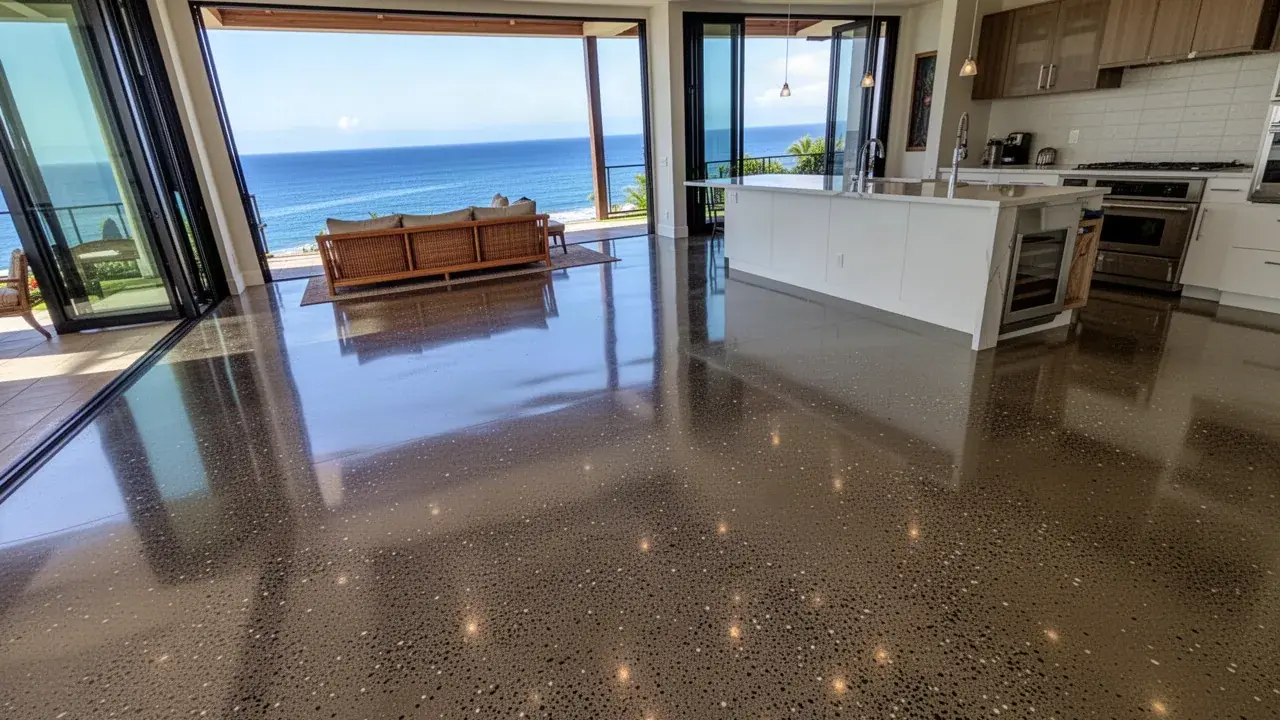
Polished Concrete Floor Services for Homes, Shops and Warehouses
Concrete polishing is a mechanical process. Heavy planetary grinders fitted with diamond tooling cut the slab down in stages, a chemical densifier hardens it, and finer and finer resin diamonds bring up the shine.
The result is a dense, dust-proof surface that can last decades with simple upkeep. It suits slab-on-grade homes going for a clean modern look, retail and restaurant floors, Central Maui warehouses and workshops, gyms, and busy offices.
Every polished concrete floor we quote includes:
- Grinding off old adhesive, thinset and coatings
- Crack, joint and spall repair with color-matched filler
- Grinding to your chosen aggregate exposure
- Densifier, progressive polishing and a guard coat
- Edge work along walls, cabinets and door jambs
- Dust control, cleanup and care instructions
If you want color, a seamless coating or chemical resistance for a garage or kitchen, our epoxy flooring and concrete coatings service is the better fit.
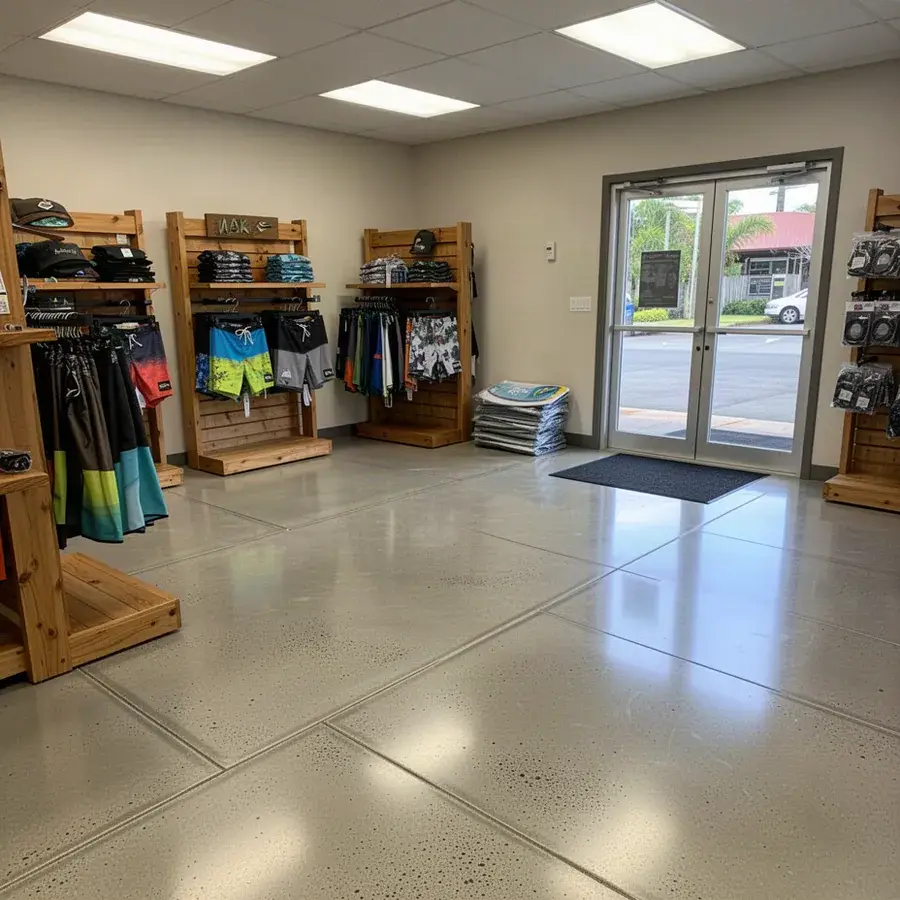
Choose Your Look: Aggregate Exposure and Gloss
Two choices define a polished floor: how deep we grind, which sets how much stone shows, and how far we polish, which sets the sheen. The Concrete Polishing Association of America’s exposure classes and gloss levels give everyone the same vocabulary.
| Exposure | What you see | Approximate grind depth | Cost and appearance |
|---|---|---|---|
| Cream (Class A) | Smooth cement paste, little or no stone | Surface only | Lowest cost; shows every trowel mark and patch |
| Salt and pepper (Class B) | Fine sand and tiny stone tips | About 1/16 inch | Low to mid cost; hides wear well |
| Medium aggregate (Class C) | Mid-size stone across the floor | About 1/8 inch | Higher cost; more passes and tooling |
| Full aggregate (Class D) | Large exposed stone, terrazzo-like | About 1/4 inch | Highest cost; best on slabs poured for it |
| Gloss level | Final resin grit | Look |
|---|---|---|
| Level 1, ground | Up to about 100 | Flat and matte |
| Level 2, satin | 200 to 400 | Low sheen that hides scuffs |
| Level 3, semi-gloss | 800 | Clear reflection seen at a distance |
| Level 4, high gloss | 1,500 to 3,000 | Mirror-like reflection |
Most polished concrete projects on Maui land between $5 and $14 per sq ft. A satin cream polish on a sound slab sits at the low end, while full aggregate at high gloss, or an old slab full of glue and patches, sits near the top.
For homes we usually suggest salt and pepper at Level 2 or 3, because it hides sand scratches far better than a mirror finish. Your written quote gives the exact number after we see and test the slab.
How Concrete Polishing Works
Polishing is a sequence of passes, and each one removes the scratches left by the one before. Skipping grits is how rushed jobs end up hazy, with swirl marks that show when low sun comes through a lanai door.
Grinding to Your Chosen Exposure
1 to 3 days
Metal-bond diamonds, usually starting around 30 or 40 grit and moving through 80 and 150, cut the surface flat and open up the aggregate. Edges and corners are done with smaller hand grinders so the finish runs right to the wall.
Densifying the Slab
Same day
A lithium silicate densifier soaks in and reacts with free lime in the concrete to form calcium silicate hydrate, the compound that gives concrete its strength. The surface becomes harder and less porous, so it polishes better and stops dusting. Sodium silicate does a similar job but leaves more residue, so we mostly use lithium indoors.
Progressive Resin Polishing
1 to 2 days
Resin-bond diamond pads take the floor from about 100 grit through 200, 400 and 800, then on to 1,500 or 3,000 for high gloss. We stop at the grit that matches the sheen you chose from the test area.
Guard Coat and Burnish
Half a day
A thin penetrating stain guard is applied and burnished in with a high-speed burnisher. It holds off oil, wine, coffee and sunscreen long enough to wipe them up, and it is easy to refresh years later.
Want to see your slab polished first?
We grind and polish a small test area so you can judge the stone and sheen in your own light.
Polishing an Old Slab vs a New Pour
A new slab poured with polishing in mind gives the most even result, and an existing slab gives a floor with more character. Both make good floors, as long as expectations are set before the grinder starts.
Under old carpet and tile, Maui slabs carry their history. Expect tack strip nail holes, plumbing trench patches in a different color, thinset ridges and adhesive shadows that stay slightly darker even after grinding.
Polishing reveals these marks rather than hiding them. If a slab is too patched to show, an overlay from our concrete floor installation service is the better route.
For a new pour, we ask your concrete contractor for a hard steel-trowel finish, no curing compound and protection from rust, paint and drywall mud. Old flooring comes off first through our floor removal and disposal service, which tests older tile and black mastic for asbestos before anything is broken up.
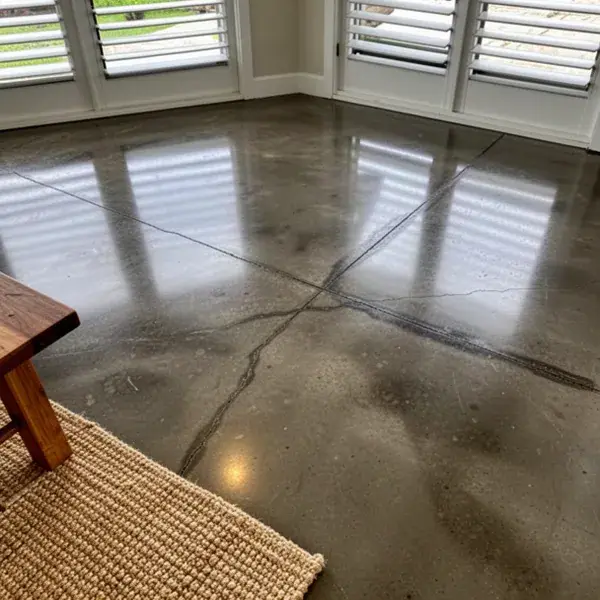
Dust Control During Grinding
We control dust by grinding wet, or by grinding dry with shrouded heads connected to a HEPA dust extractor. Concrete dust contains crystalline silica, and OSHA’s silica standard for construction requires controls like these on floor grinders.
Wet grinding
Water keeps dust down and cools the tooling, but it creates a gray slurry that must be vacuumed up and disposed of properly. We use it mostly on new construction and outdoor slabs where slurry is easy to contain.
Dry grinding with HEPA extraction
Inside occupied homes and open businesses, we usually grind dry with vacuum shrouds and HEPA-filtered extractors. It keeps the rest of the building cleaner and lets us read the floor as we work.
We still seal doorways and air conditioning returns with plastic sheeting. Please clear the room of anything you would not want dusted, including electronics and artwork.
Keeping Polished Concrete Clean in Sand and Salt
Sand is the main enemy of a polished floor on Maui, because each grain scratches the shine like fine sandpaper. The fix is simple: stop grit at the door and clean with the right products.
- Walk-off mats at every exterior door and lanai slider, long enough for 3 to 4 steps
- A daily dry dust mop with a microfiber pad
- Damp mopping or auto-scrubbing with a pH-neutral cleaner, never vinegar, citrus or bleach, which etch cement paste
- Wiping up wine, soda, coffee and sunscreen promptly
- Re-burnishing traffic lanes every 6 to 12 months in commercial spaces and every few years at home, with fresh guard as needed
For shops, restaurants and offices, our commercial flooring services explain how we plan grinding and maintenance work around a business that needs to stay open.
FAQ
Polished Concrete FAQ
Is polished concrete slippery?
Clean and dry, polished concrete has good traction for normal walking. Wet, sandy or oily, it gets slick, and a high-gloss finish is slicker than satin.
For entries, bathrooms and lanai thresholds we recommend a satin finish, walk-off mats and, where needed, an anti-slip treatment. Commercial clients can have the floor's wet dynamic coefficient of friction (DCOF) tested after polishing.
Can any concrete floor be polished?
Most sound slabs can, but not all. Very soft or low-strength concrete, heavily cracked or spalled slabs, thin toppings and lightweight concrete may not grind to a good finish, and slabs with old epoxy or paint need that coating removed first.
We check hardness with a scratch test and a test grind before quoting. If your slab will not polish well, we will say so and suggest an overlay from our concrete floor installation service instead.
How long does a polished concrete floor last?
The polished slab can last as long as the building, because there is no coating to wear through. What wears is the shine and the guard, mostly in walkways and at doors.
Homes typically need a re-burnish and fresh guard every 2 to 5 years, and busy stores and warehouses every 6 to 12 months. Even a dull, worn floor can usually be brought back with a light polish rather than a full regrind.
Related concrete and commercial floor services
Get a quote
See How Your Slab Will Polish
Tell us where the slab is, what covers it now and the look you want. We will measure, run a test patch where possible and send a written quote for your polished concrete floor.
- Mon to Sat 7am to 9pm, Sun 9am to 9pm
- 1710 W Kaahumanu Ave, Wailuku, HI 96793
- Licensed, insured and backed by a 1-year labor warranty