Engineered Hardwood Installation on Maui
Maui Prestige Flooring installs engineered hardwood flooring on concrete slabs, in condos and over raised wood floors across Maui. Over more than 16 years and 1,700+ jobs, engineered wood has become the way we put real oak, hickory and walnut into homes that could never take solid boards.
Most Maui houses and nearly every condo sit on concrete, and concrete here often carries ground moisture. Engineered wood is built to live on that slab, but only when the slab is tested, flattened and sealed first, and that prep is where we spend our extra hours.
From Kahului ranch homes to Kaanapali condos, we glue, float or nail each floor to suit the building and its rules. The work carries our 1-year labor warranty alongside the manufacturer's finish and structural warranty.
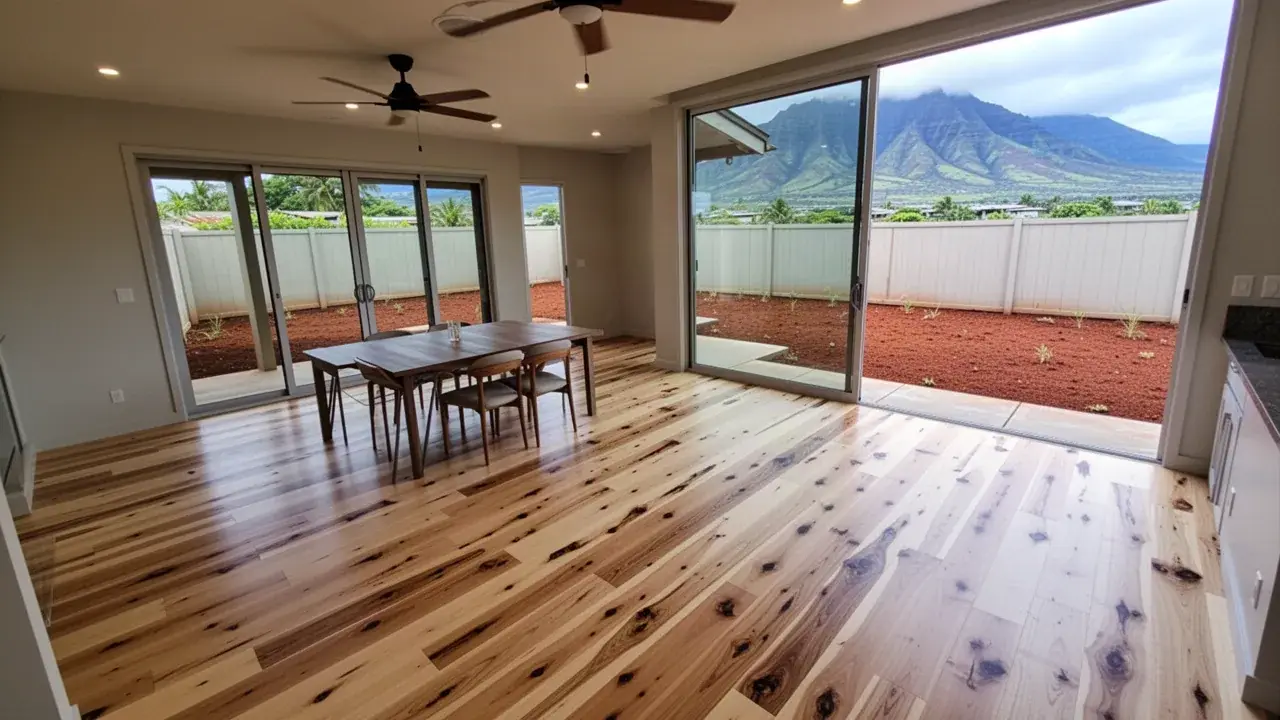
Engineered Hardwood Flooring Installation for Slab Homes and Condos
Engineered hardwood flooring is a real wood top layer, called the wear layer, bonded to a core of cross-laminated plywood or high-density fiberboard (HDF). From above it looks and feels like solid wood, because the surface is solid wood.
It is made for the floors most Maui homes actually have: concrete slabs, condo decks and ground floors where solid boards would cup. It also suits owners who want wide, long planks without the seasonal gaps of solid wood.
Every engineered hardwood installation we quote includes:
- Furniture moving and removal of the old floor
- Slab moisture testing with the readings recorded
- Grinding and self-leveling to the plank maker’s flatness spec
- A moisture-control adhesive or a separate barrier where needed
- Glue-down, floating or nail-down installation
- Transitions, baseboards or quarter round, and cleanup
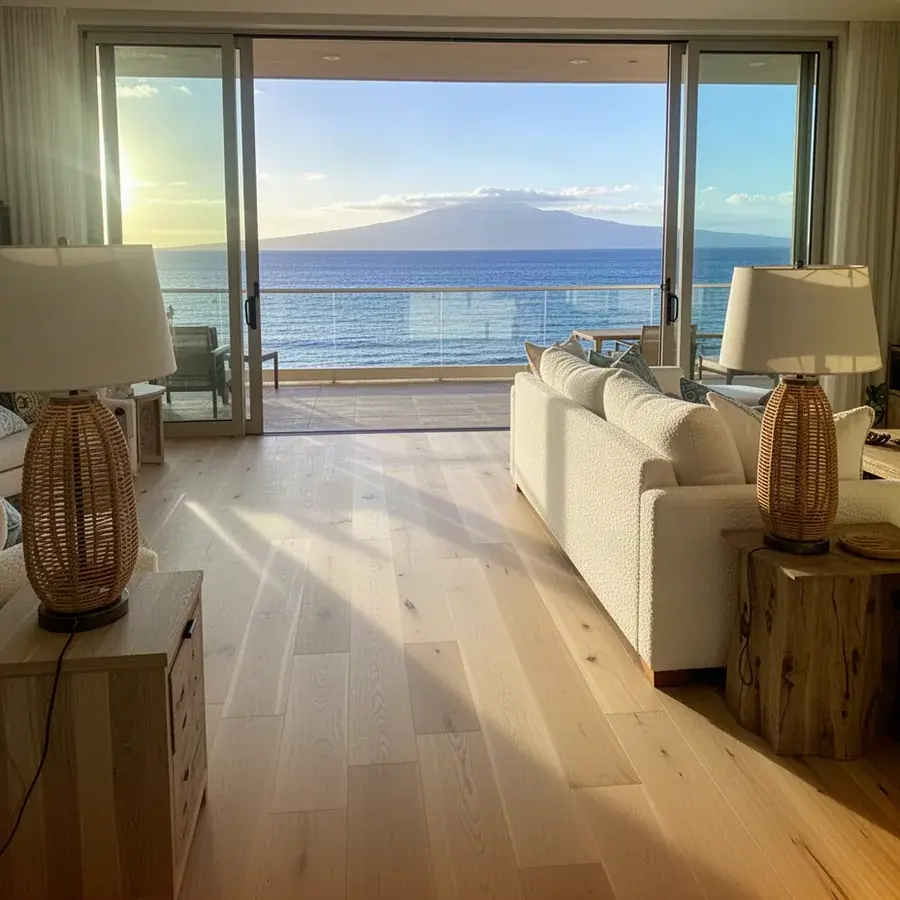
Why Engineered Wood Handles Maui Slabs Better
Engineered wood moves far less than solid wood because its core layers run in alternating directions, so each layer holds the next one in check. When island humidity climbs, a solid board swells across its width while an engineered plank barely changes size.
Cross-ply core
Plywood plies are stacked with the grain turned 90 degrees each time. Wood barely expands along its length, so every layer pins the one above and below.
Less wood to move
Only the top 2 to 6 mm is solid hardwood. A thinner slice of wood simply has less to swell and shrink than a 3/4 inch board.
Bonded to the slab
Glued directly to concrete, the plank cannot rock or bow. That kills the hollow sound and keeps edges flat through wet and dry seasons.
Many engineered products are also approved over radiant heated floors, which solid wood usually is not. That makes engineered planks a good match for cooler Upcountry homes that want warm wood underfoot.
Choosing Your Engineered Floor
Three specs decide how an engineered floor performs and how long it lasts: the wear layer, the core and the plank size. Brands we install include Shaw, Mohawk and Provenza, and we compare spec sheets with you before you order.
Wear Layer Thickness and Future Refinishing
The wear layer is the solid wood on top, and its thickness sets how many times the floor can be sanded. A full sanding removes roughly 1/32 inch, a little under 1 mm, so thin veneers can only be screened and recoated. See the table below.
Plywood, HDF and Rigid Cores
- Multi-ply plywood: the most stable core in humid rooms and our first pick for glue-down slabs
- HDF: flatter and lower cost, common in click products, but swells if water gets in at the edges
- Rigid core: a waterproof composite under a wood veneer, floating only, often with a thinner wear layer
Wide Plank and Long-Length Boards
Wide plank hardwood flooring, 7 to 10 inches across and often 6 feet or longer, makes a room look larger and calmer. The trade-off is flatness: a long, stiff plank rocks over dips a narrow board would ride, so we level to tighter tolerances such as 1/8 inch over 6 feet.
| Wear layer | Full sandings it typically allows | Good fit for |
|---|---|---|
| Under 1 mm | None, screen and recoat only | Budget projects and light-use rooms |
| 2 mm | About 1, done carefully | Bedrooms and low-traffic condos |
| 3 mm | 1 to 2 | Most family homes |
| 4 mm | 2 to 3 | Busy homes and long-term owners |
| 6 mm | 3 to 4, close to solid wood | Homes planned for decades |
Glue-Down, Floating or Nail-Down Installation
On a Maui slab, glue-down is our default for engineered hardwood. Floating suits condos and fast schedules, and nail-down is reserved for raised floors with a plywood subfloor.
| Method | Best subfloor | Sound | Feel underfoot | Condo suitability |
|---|---|---|---|---|
| Glue-down | Concrete slab, also plywood | Quiet, no hollow tap | Solid, like traditional hardwood | Good with an approved sound mat |
| Floating | Slab, plywood or sound existing tile | Can sound hollow without a good pad | Slight give | Very good over a rated acoustic pad |
| Nail-down or staple | Plywood over joists only | Quiet when fastened well | Firm | Rare, since condos are concrete |
For glue-down work we use moisture-cure urethane adhesives from makers such as Bostik, spread with the trowel notch the plank maker specifies. Some of these adhesives double as a moisture membrane when applied at the full rate, which can replace a separate barrier on slabs with moderate readings.
Floating floors get a 1/2 inch expansion gap at every wall and a quality underlayment, never the thin foam that comes free with a pallet. Nail-down engineered planks use shorter cleats than solid wood and the same paper underlayment over plywood.
Not sure your slab is ready for wood?
We test the moisture, check flatness with a straightedge and tell you exactly what prep it needs before you order.
Slab Prep Before Engineered Wood Goes Down
A slab has to be dry enough, flat enough and clean enough before any engineered plank touches it. Skipping one of the three is the most common reason engineered floors fail on Maui, showing up as hollow spots, cupped boards or open end joints.
- Moisture testing. We test several spots and compare the results with the adhesive and plank makers’ limits. Our moisture vapor barrier installation page explains the test methods and barrier systems.
- Membrane or adhesive choice. Moderate readings are handled by a moisture-control adhesive, and higher readings get a dedicated membrane first.
- Grinding and leveling. High spots are ground and low spots filled until a straightedge shows the slab within spec, a process covered in depth by our subfloor repair and floor leveling service.
- Cleaning. Old adhesive, paint and dust are removed so the new glue bonds to bare concrete.
Black cutback adhesive under old vinyl tile in pre-1980 homes may contain asbestos and is tested before it is scraped, through our floor removal and disposal service.
Engineered Hardwood in Maui Condos
Engineered hardwood is one of the few real wood floors most Maui condo associations will approve, provided it sits on an acoustic underlayment that meets the building’s sound rating. Many AOAOs ask for IIC 50 or higher, and some set their own stricter minimum.
We help you gather the product and underlayment data sheets your board needs, then schedule around elevator bookings, loading zones and quiet hours. Our condo flooring service explains the approval process, and our acoustic underlayment installation page compares rubber and cork pads such as Regupol.
FAQ
Engineered Hardwood Questions
Can engineered hardwood be installed on concrete?
Yes. Engineered hardwood on concrete is the most common wood floor we install on Maui, either glued directly to the slab or floated over an underlayment. The slab must pass a moisture test, be flat to the manufacturer's tolerance and be clean of old adhesive first.
Can engineered hardwood be refinished?
It depends on the wear layer. A 3 mm wear layer usually allows one or two full sandings, 4 to 6 mm allows two to four, and thin veneers under about 1 mm can only take a light screen and recoat.
Ask for the wear layer thickness in millimeters before you buy, not just the total plank thickness. Our hardwood floor refinishing service can tell you what an existing floor will take.
Is engineered hardwood waterproof?
No. Some products are marketed as water-resistant because of tighter joints and better finishes, but standing water will still swell the wood and the core.
For bathrooms, laundry rooms and entries off a pool deck, we recommend porcelain tile or rigid core vinyl instead. Our luxury vinyl plank installation page covers the waterproof options.
How long does an engineered wood floor last?
A good engineered floor with a 3 mm or thicker wear layer typically lasts 25 years or more, and floors with 4 to 6 mm layers can approach the life of solid wood. Thin-veneer products usually last 10 to 20 years before the surface wears through.
Steady indoor humidity, felt pads, walk-off mats for sand and red dirt, and a recoat before the finish wears through all extend that life.
Where we install engineered hardwood on Maui
Get a quote
Get an Engineered Hardwood Quote
Tell us whether you are on a slab, in a condo or on a raised floor, plus the rooms and the look you want. We will test the subfloor, bring samples and send a written quote for your engineered hardwood.
- Mon to Sat 7am to 9pm, Sun 9am to 9pm
- 1710 W Kaahumanu Ave, Wailuku, HI 96793
- Licensed, insured and backed by a 1-year labor warranty