Epoxy Flooring and Concrete Coatings on Maui
Maui Prestige Flooring installs epoxy flooring and concrete coatings in garages, commercial kitchens, warehouses, showrooms and workshops across Maui. Over 16 years and 1,700+ flooring jobs, we have seen that coatings rarely fail because of the resin; they fail because of the slab under it.
That is why our coating jobs start with a moisture test and a diamond grind, not a quick acid etch. We then match the system to the space: 100% solids epoxy, flake broadcast, metallic, polyaspartic or urethane cement.
You get a written quote that spells out the prep, every coat and the cure times, plus a 1-year labor warranty on our workmanship. Near the ocean, we also plan for salt air and the UV that pours through an open garage door.
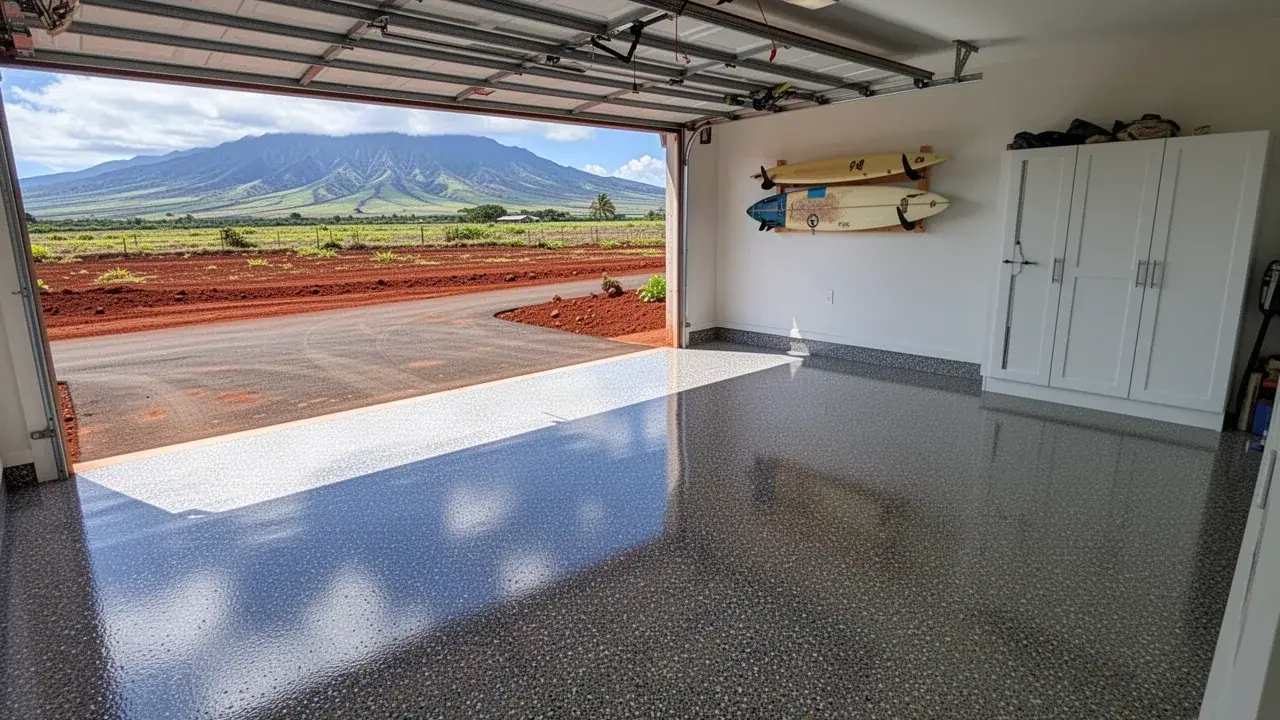
Epoxy Flooring and Concrete Coating Services on Maui
A concrete coating is a resin system bonded to a prepared slab: a primer that soaks in, one or more build coats for thickness and color, and a topcoat that takes the wear. Done right, it gives a seamless, cleanable, chemical-resistant floor that hides a stained or patched slab completely.
Every epoxy floor installation we quote includes:
- Moisture testing of the slab
- Diamond grinding or shot blasting to the right surface profile
- Crack, joint and spall repair with epoxy or polyurea filler
- Primer and build coat, with flake, quartz or metallic pigment as chosen
- A UV-stable topcoat and, where needed, slip-resistant aggregate
- Cove base or edge detailing in kitchens and wash-down areas
We coat home garages in Kihei and Wailea, restaurant kitchens, Central Maui warehouses and auto shops, retail showrooms and gyms. For restaurants, offices and resorts, our commercial flooring services explain how we schedule coating work around a business.
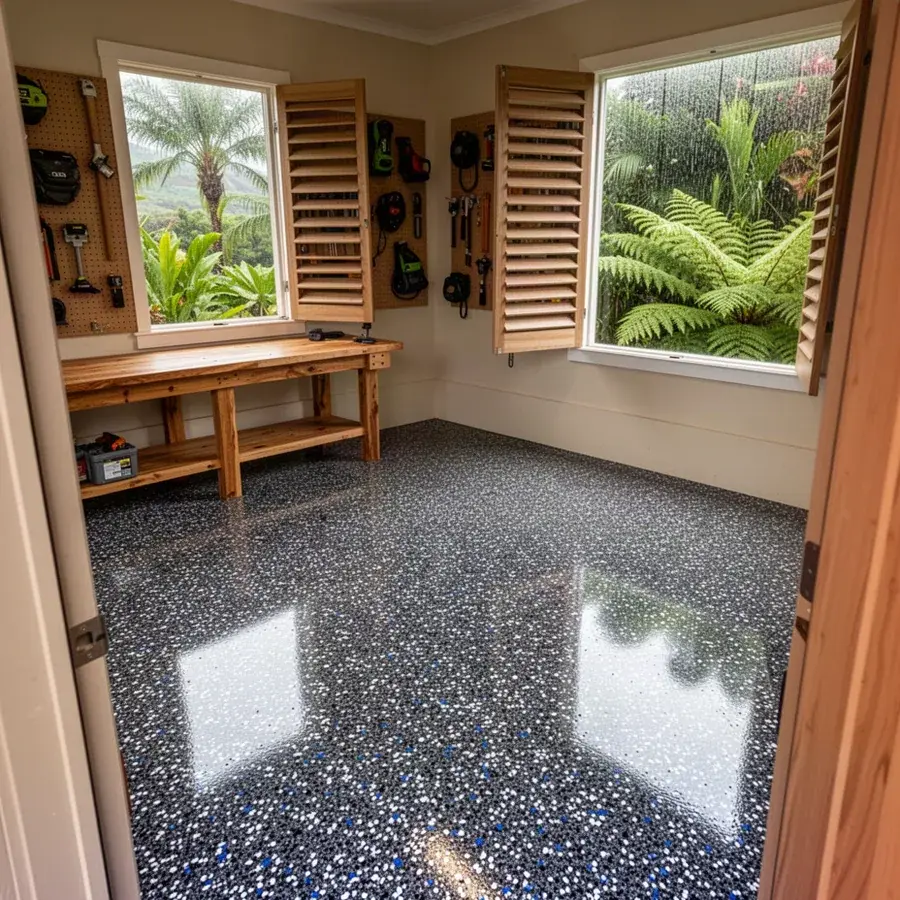
Coating Systems We Install
Five systems cover nearly every coating job on the island. Many floors combine two, such as an epoxy base for bond and build with a polyaspartic or urethane topcoat for wear and UV.
Solid-Color Epoxy
100% solids epoxy goes on thick, roughly 10 to 20 mils per coat, with no solvents to shrink or smell. It is the workhorse for warehouses, workshops and storage rooms, in gray or tan field colors with safety-yellow lines that stand up to pallet jacks and forklifts.
Flake (Chip) Floors
Colored vinyl flakes are broadcast into a wet base coat, scraped and locked under a clear topcoat. The speckled finish hides red dirt, sand and tire marks, and its texture adds grip, which is why it is the most popular garage floor coating.
Metallic Epoxy
Metallic pigments swirled through a clear epoxy create a marbled, three-dimensional look, and no two floors come out alike. It suits showrooms, salons, bars and statement living spaces, but it shows scratches and needs a hard topcoat.
Polyaspartic Topcoats
Polyaspartic is an aliphatic polyurea that does not yellow in sunlight and cures in hours instead of days. We use it as the topcoat over epoxy and flake floors in open garages, covered lanais and any space that gets direct sun.
Urethane Cement for Commercial Kitchens
Urethane cement, such as Sikafloor PurCem, is a troweled cement and polyurethane hybrid laid about 1/4 inch thick. It handles boiling-water washdowns, steam cleaning, grease and the thermal shock that cracks ordinary epoxy, and it tolerates more slab moisture.
Epoxy vs Polyaspartic Near the Ocean
Epoxy bonds and builds better, while polyaspartic survives sun and installs faster. Near the ocean, where garages stand open to UV and salt air, we usually use both: an epoxy base under a polyaspartic topcoat.
| Factor | Epoxy (100% solids) | Polyaspartic |
|---|---|---|
| UV exposure | Ambers and yellows in sunlight, often within a year or two | UV stable, keeps its color |
| Cure time | Walk on in 12 to 24 hours, drive on in 5 to 7 days | Walk on in about 4 to 6 hours, drive on in 24 to 48 hours |
| Bond and build | Deep penetration and high build per coat | Thinner coats, shorter working time |
| Salt and chemicals | Good resistance to salt, oil and most chemicals | Very good, and resists hot tire pickup |
| Installing in heat | Long working time, forgiving | Can cure too fast on a hot Kihei afternoon |
| Typical cost | Lower material cost | Higher material cost, but saves a day of labor |
Salt air also corrodes steel near the surface of coastal slabs, which shows up as rust stains and small spalls. We cut out and repair those spots before coating so they do not bleed or blister through the new floor.
Garage floor looking tired?
We test the slab, grind it properly and put down a coating built for Maui sun and salt.
Why Coatings Peel, and How Prep Prevents It
Most coating failures come from moisture vapor, a smooth or dirty surface, or the wrong product for the job. Big-box garage kits often fail for all three reasons: they rely on acid etching, go on thin and get rolled onto a damp slab.
- Moisture vapor: vapor rising through an older slab with no vapor retarder pushes under the coating and forms blisters. Many standard epoxies list a maximum slab RH in the 75 to 85 percent range, so we test first and switch to a moisture-tolerant epoxy primer when readings are high.
- Surface profile: coatings need texture to grip, rated on the ICRI concrete surface profile (CSP) scale from 1 to 10. Diamond grinding gives about CSP 2 to 3 for thin coats, and shot blasting gives CSP 3 to 5 for broadcast systems and urethane cement.
- Contamination: oil, old sealers and curing compounds stop resin from bonding. A water-drop test reveals sealers, and degreasing plus grinding removes oil before primer goes on.
- Hot tire pickup: hot tires soften cheap, thin coatings and pull them up. A fully cured epoxy or polyaspartic topcoat resists it.
Our slab moisture testing and vapor barrier service explains the ASTM tests behind these readings and the mitigation options when a slab is too wet.
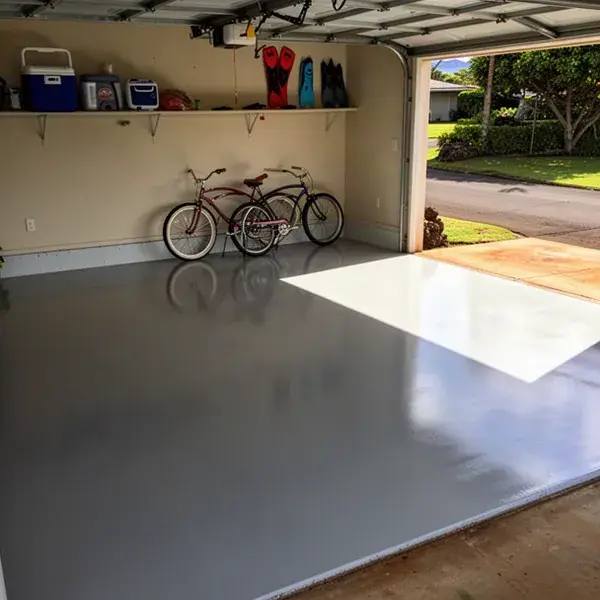
Slip Resistance and Finish Choices
A smooth, high-gloss coating gets slippery when wet, so in wet areas we build traction into the topcoat. How much grip depends on the room and what ends up on the floor.
Light texture
A fine aluminum oxide grit mixed into the topcoat adds grip without feeling rough on bare feet. It suits garages, laundry rooms and showroom walkways.
Medium broadcast
A flake floor with a lightly textured topcoat, or a quartz broadcast system, gives more grip for covered lanais and entries where sand and water get tracked in.
Heavy texture
Commercial kitchens, walk-in coolers and wash-down areas get a coarse quartz or urethane cement texture that stays grippy with grease and water on it.
Sheen matters too. Satin and matte topcoats hide scratches and dust better than high gloss, which is why we steer most garage owners toward satin. If you would rather see the slab itself than cover it, compare our polished concrete floor service or the stains and overlays on our concrete floor installation page.
How We Coat a Floor, Day by Day
Test and plan
Before install day
We take moisture readings, check for old sealers and measure the space. Your quote lists the system, colors and cure times.
Day 1: Grind and repair
4 to 8 hours
We diamond grind or shot blast the slab, vacuum every bit of dust and fill cracks, joints and spalls. Edges are ground by hand.
Day 1: Primer and base coat
Same day
The primer goes on, then the pigmented base coat. On flake floors we broadcast chips to full coverage while the base is still wet.
Day 2: Scrape and topcoat
4 to 6 hours
Loose flakes are scraped and vacuumed, then the clear topcoat goes on, with grit where needed. Metallic and multi-coat commercial systems add 1 to 2 days.
Walk-on
4 to 24 hours
Polyaspartic topcoats take foot traffic in about 4 to 6 hours. Epoxy topcoats need about 12 to 24 hours.
Drive-on and full cure
1 to 7 days
You can usually park on polyaspartic after 24 to 48 hours and on epoxy after 5 to 7 days. Heavy chemicals and rolling racks wait for full cure, usually about a week.
A typical 400 to 500 sq ft two-car garage takes 2 days with a flake and polyaspartic system. A commercial kitchen with urethane cement and cove base usually needs 3 to 5 days of closure, which we plan with you well ahead.
FAQ
Epoxy Flooring FAQ
How long does epoxy flooring last in Hawaii?
A well-prepped residential garage coating with a polyaspartic topcoat typically lasts 10 to 20 years before it needs more than a fresh topcoat. Commercial floors under forklifts and daily washdowns usually need a topcoat renewal every few years.
What shortens coating life in Hawaii is moisture vapor from the slab, UV yellowing on plain epoxy and sand ground in at the door. Testing, the right topcoat and walk-off mats deal with all three.
When can I park on a new garage floor coating?
With a polyaspartic topcoat, usually 24 to 48 hours after the last coat. With an epoxy topcoat, plan on 5 to 7 days, and longer in cool, damp Upcountry weather.
Hot tires on a coating that has not fully cured are a common cause of tire marks and lifting, so we leave a cure card with your exact walk-on and drive-on dates.
How much does epoxy flooring cost?
Most residential epoxy coatings on Maui, such as a flake garage floor, land between $6 and $12 per sq ft installed. Commercial systems, including heavy broadcast floors and urethane cement for kitchens, typically run $8 to $16 per sq ft.
The main cost drivers are slab condition, crack and spall repair, moisture mitigation if the slab tests high, the system you choose and the size of the area, since small rooms cost more per foot. Your written quote is the exact number.
Get a quote
Get a Coating Quote for Your Floor
Send us the room, the rough size and a photo of the slab as it is today. We will test it, measure it and send a written quote with the coating system and cure times spelled out.
- Mon to Sat 7am to 9pm, Sun 9am to 9pm
- 1710 W Kaahumanu Ave, Wailuku, HI 96793
- Licensed, insured and backed by a 1-year labor warranty