Parquet Flooring Installation on Maui
Maui Prestige Flooring installs new parquet floors and restores worn ones in homes, condos and older buildings across Maui. Our 16+ years and 1,700+ flooring jobs cover everything from 1970s finger-block parquet hiding under carpet to new basketweave and Versailles floors in custom homes.
Parquet is small pieces of wood glued down in a repeating geometric pattern, so it lives or dies by its adhesive and the slab under it. We find out why old blocks came loose before we fix them, so the repair holds.
Whether you want a whole new floor or a few blocks reset and the room refinished, you get a written quote and a 1-year labor warranty.
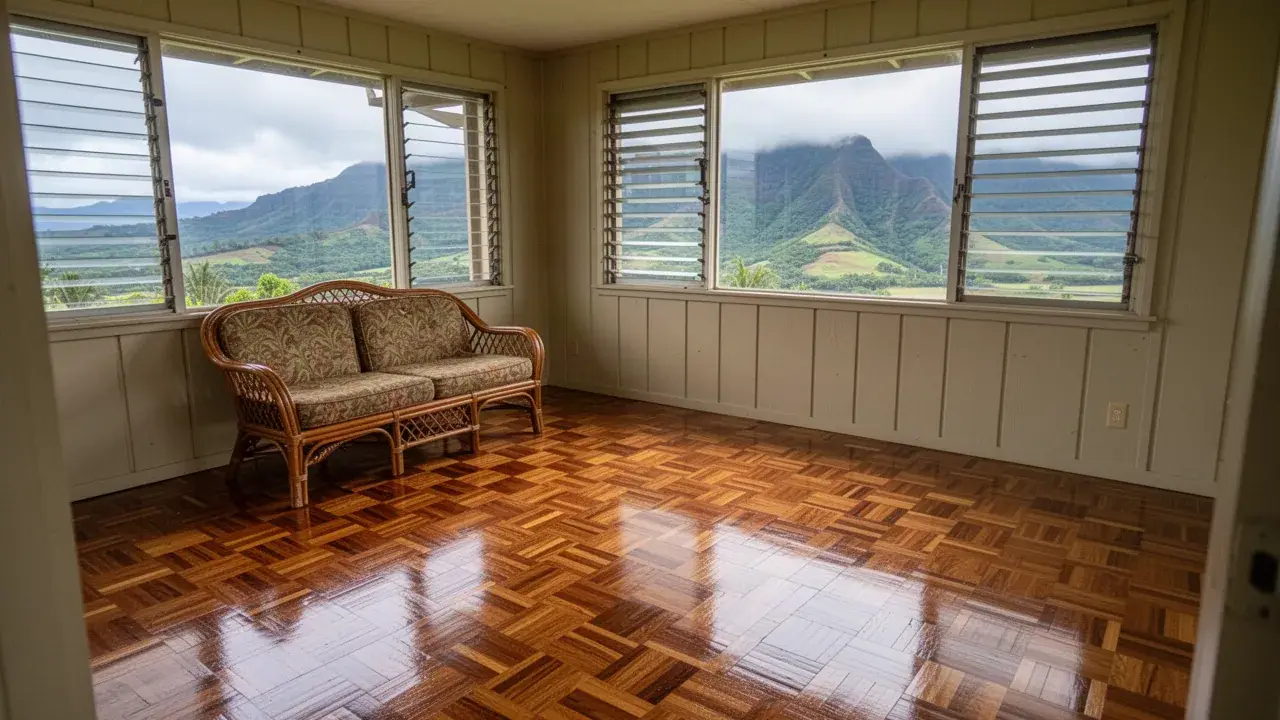
Parquet Flooring Installation and Restoration Services
Parquet is a wood floor built from small slats or blocks set in a repeating geometric pattern, glued directly to the subfloor rather than nailed. It suits owners who want a statement floor with old-world character, and owners of existing parquet who would rather save it than tear it out.
We handle both sides of the work. New floors are laid out from the center of the room and glued down, while restoration jobs start with finding and fixing whatever let the old blocks loose.
Parquet work we quote includes:
- Moisture readings and slab or plywood prep
- Pattern layout from the room’s center point
- Glue-down installation with a urethane wood adhesive
- Sanding flat, optional stain and finish coats
- Resetting loose blocks and replacing missing ones
- Thresholds, baseboards or quarter round, and cleanup
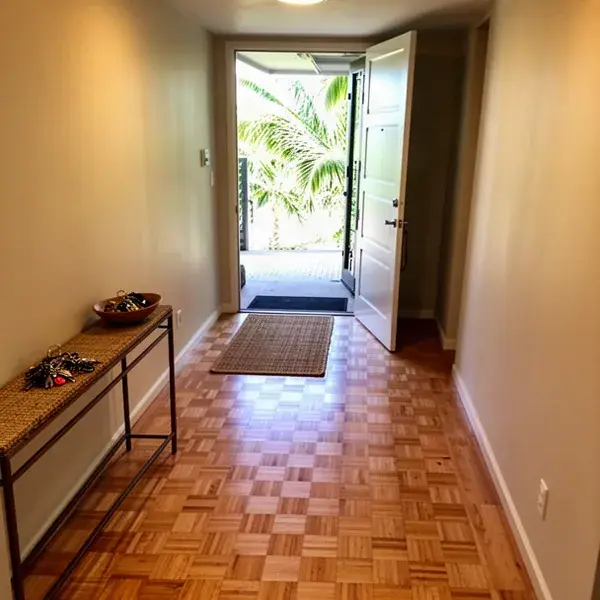
Parquet Patterns We Install
Most parquet falls into three families: stock blocks, large pre-made panels, and the thin mosaic squares found in older homes. Each one installs, sands and ages a little differently.
Block and Basketweave Parquet
Block parquet is the classic square: four to six short slats side by side, each block turned 90 degrees from its neighbor to make a checkerboard of grain. Basketweave pairs slats so the pattern looks woven.
Both use stock-sized blocks, which keeps cost closer to a standard hardwood floor, and both work well in bedrooms, dens and offices.
Versailles and Panel Parquet
Versailles panels, named for the French palace floors, are large squares of interlaced diagonal strips held inside a frame, often 30 inches or more across. They arrive pre-assembled from specialty mills.
That makes them high-end in price and lead time, and best saved for formal living rooms, entries and dining rooms.
Finger and Mosaic Parquet in Older Homes
Finger-block or mosaic parquet is made of tiny slats, roughly 3/4 inch wide, held together by a mesh or paper backing in 9 to 12 inch squares. It was a popular, budget-friendly floor in condos and homes of the 1960s and 1970s.
It still turns up under old carpet, and much of it can be reset and refinished if enough wood remains.
Parquet also comes in two edge styles. Unfinished square-edge blocks are sanded flat and finished on site for a tight, smooth surface, while prefinished microbevel blocks skip the sanding but leave tiny grooves that outline every block and collect Maui’s fine red dirt.
For larger-scale patterns, our herringbone floor installation page covers herringbone and chevron, and our custom pattern wood floors page shows borders and medallions that frame a parquet field.
Found parquet under your old carpet?
Send us a photo. Many older floors can be reset and refinished for far less than a new one.
New Parquet or Restore the Old Floor?
Restore when the wood is mostly sound and only some blocks are loose or worn. Replace when large areas are loose, water-stained or already sanded thin.
| Condition | Restore it | Replace it |
|---|---|---|
| Loose blocks | Patches, roughly under 15 percent of the floor | Adhesive failing across the whole room |
| Finish wear | Grey traffic paths, scratches, dull finish | Wood sanded down to the tongue or backing |
| Missing pieces | A few blocks we can match or borrow from a closet | Large sections gone, species unavailable |
| Water damage | Small, dried areas without black staining | Cupped, black-stained or moldy blocks |
| Typical Maui cost | Refinishing about $5 to $9 per sq ft, plus block resets | New pattern floors often $18 to $35+ per sq ft installed |
Sanding parquet is harder than sanding plank flooring because the grain runs in several directions at once. We make the first passes on a diagonal, then flatten with a multidisc sander such as a Bona FlexiSand, which cuts evenly across grain changes without gouging.
Thin finger parquet can usually take only one or two full sandings in its life, so we check thickness before promising a refinish. The full grit sequence and finish choices are on our hardwood floor sanding and refinishing page.
If only a small area is damaged, our hardwood floor repair team can reset or replace blocks without refinishing the whole house.
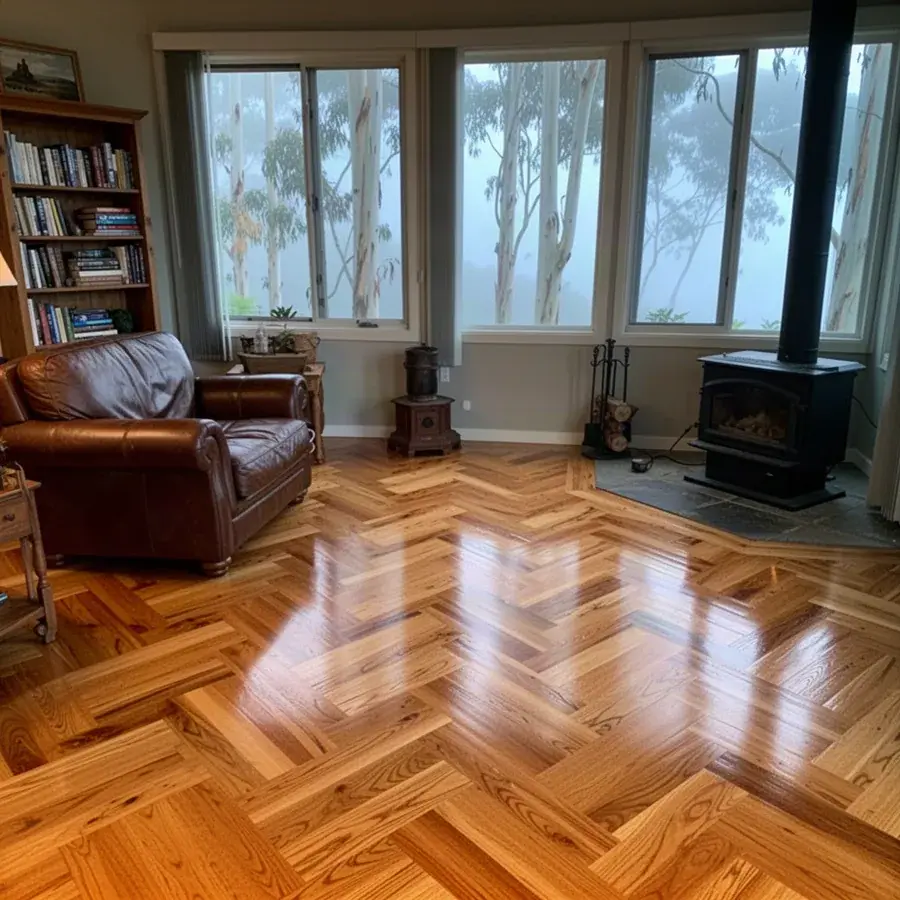
Why Old Parquet Comes Loose
Old parquet comes loose for three main reasons: moisture rising through the slab, adhesive that has dried out, and constant swelling and shrinking from humidity swings. Usually two of the three are at work together.
Slab moisture
Many older Maui slabs were poured without a vapor retarder, so ground moisture keeps reaching the underside of the blocks. Over decades it softens the bond until blocks tent or rock underfoot.
Brittle adhesive
Mid-century parquet was often set in black asphalt-based cutback mastic, which turns brittle with age. Once it lets go, blocks click and sound hollow when you step on them.
Humidity swings
Coastal Maui air usually sits around 70 to 80 percent relative humidity. Rooms that sit closed and hot, then run hard on air conditioning, make small blocks swell and shrink until the edges break free.
Before resetting anything, we take moisture readings and lift a few blocks to inspect the adhesive. If the slab is wet, a moisture vapor barrier for flooring or a moisture-control adhesive becomes part of the fix, otherwise new glue fails the same way.
Check the Black Adhesive Before Removal
If your old parquet sits on black, tar-like adhesive, have it tested for asbestos before anyone scrapes, grinds or sands it. Black cutback mastic used before about 1980 commonly contains asbestos, and the risk comes when it is turned into dust.
If the mastic tests positive, the options are licensed abatement or, where the new floor allows it, leaving the mastic sealed under the new installation. Our floor removal and disposal service explains testing and safe removal, and we confirm the path with you before work starts. We restore and replace parquet island-wide, from older condos in Kihei and Wailea to plantation-era homes in Paia and Haiku.
Our Parquet Installation Process
New parquet takes longer than plank flooring because every block is glued, then the whole floor is sanded and finished as one surface. Here is how a typical job runs.
Moisture test
Same day
We take readings across the slab or plywood and record them on your job sheet. High readings mean a barrier or moisture-control adhesive.
Level and prep
1 to 2 days
Old adhesive ridges are ground off and low spots filled. Small blocks telegraph every bump, so the base must be flat and smooth.
Dry-lay from center
Half a day
We find the room’s center, snap square reference lines and dry-lay blocks outward so cut pieces at each wall come out equal.
Glue-down
1 to 3 days
Blocks are set into freshly troweled urethane adhesive, a section at a time, and checked for tight joints and alignment as we go.
Sand flat
About 1 day
Unfinished parquet is sanded on the diagonal, then flattened with a multidisc sander so every block sits level with its neighbors.
Stain, finish and cure
2 to 3 days
Stain is optional, followed by sealer and two or more finish coats. Light foot traffic is fine after about 24 hours, with rugs back after a week or so.
A 300 square foot room of new unfinished parquet usually takes 6 to 9 working days from prep to final coat. Prefinished microbevel parquet skips sanding and finishing and saves about 3 days, while resetting and refinishing an existing condo living room typically takes 3 to 5 days.
FAQ
Parquet FAQ
Can old parquet flooring be refinished?
Usually, yes, as long as enough wood remains above the tongue or backing. Solid parquet blocks are often 5/16 to 3/4 inch thick and can take at least one more full sanding, while thin finger parquet may have one sanding left at most.
We pull a block in a closet to measure before quoting, and we reset loose blocks first so the sander cannot tear them out.
Can you replace a few missing parquet blocks?
Yes. The best match is your own floor, so we borrow blocks from inside a closet or under a built-in cabinet and fill that hidden spot with a close substitute. If none can be spared, we source new blocks in the same species and size or cut them from matching stock.
Sanding and finishing the whole room afterward blends new and old blocks far better than finishing a patch on its own.
Is parquet a good choice for a slab home on Maui?
Yes, if the slab is tested and the adhesive is chosen for it. We use a urethane wood adhesive with built-in moisture control, or add a separate vapor barrier when readings run high. Engineered parquet, with a stable plywood base, handles humidity swings better than thin solid blocks.
Where we install and restore parquet on Maui
Get a quote
Bring Your Parquet Floor Back to Life
Tell us whether you want new parquet or have an old floor worth saving, and send a photo if you can. We will inspect the blocks, test the slab and send a written quote.
- Mon to Sat 7am to 9pm, Sun 9am to 9pm
- 1710 W Kaahumanu Ave, Wailuku, HI 96793
- Licensed, insured and backed by a 1-year labor warranty