Acoustic Underlayment Installation on Maui
Maui Prestige Flooring installs acoustic underlayment under vinyl, laminate, wood and tile floors in condos, upstairs rooms, offices and hotels across Maui. Over 16 years and 1,700+ jobs, we have learned that a quiet floor depends as much on the details at the walls as on the product in the box.
Hard floors carry footsteps, dropped keys and chair scrapes straight into the slab and down to the unit below. A rated sound mat absorbs that energy before it reaches the structure.
We match the underlayment to your floor and to the IIC or STC number your building sets, then install it with the perimeter isolation that keeps the rating intact. You get a written quote and a 1-year labor warranty.
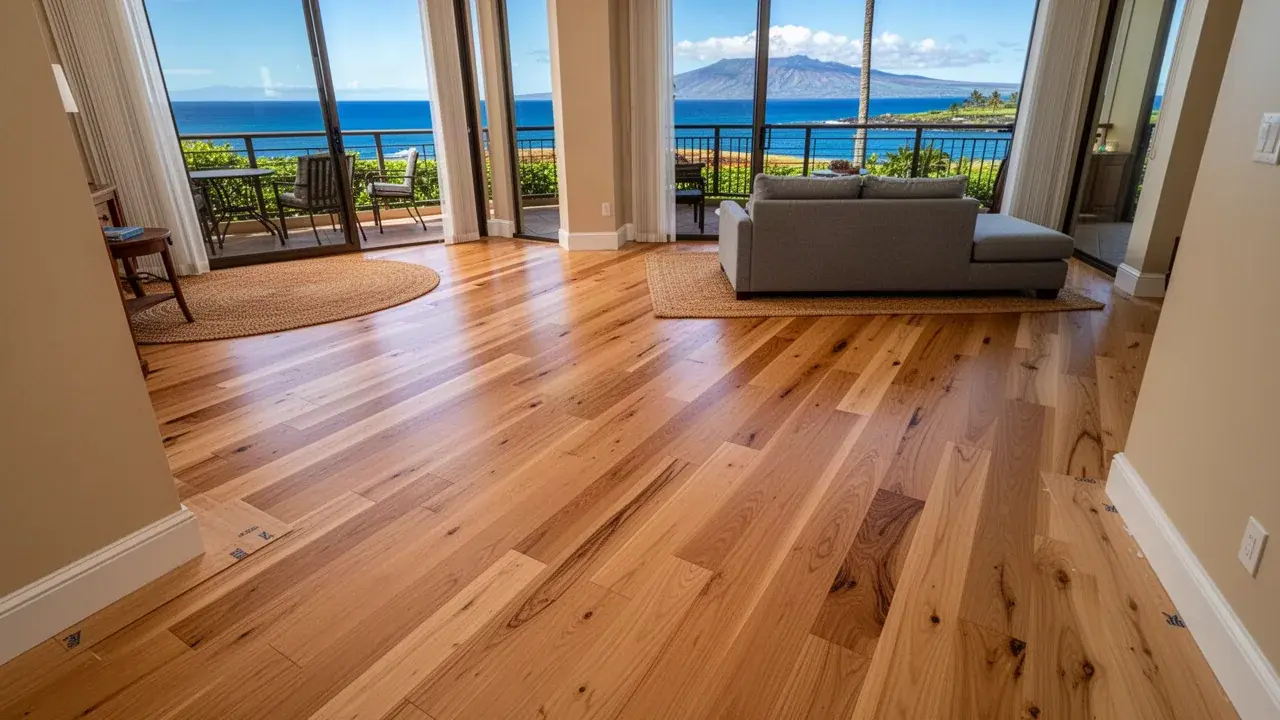
Acoustic Underlayment Installation for Quieter Floors
Acoustic underlayment is a resilient layer of rubber, cork, felt or foam placed between the slab and the finished floor. It absorbs impact energy from footsteps and dropped objects so less of it travels into the building and down to the ceiling below.
It matters most in condos with sound rules, upstairs bedrooms in two-story homes, offices above other tenants and hotel rooms stacked over each other. It also makes a hard floor feel and sound less hollow in your own space.
Every acoustic underlayment installation includes:
- Old floor removal and a flatness check of the slab
- An underlayment chosen from its published test report
- Perimeter isolation strip at walls, columns and cabinets
- Taped seams and the finished floor installed on top
- Product data sheets and test reports for your records

Condo owners also need building approval before the work starts. Our condo flooring installation service covers the association paperwork, schedules and building access, while this page focuses on the products and how they are rated.
IIC and STC Ratings in Plain Terms
IIC measures how well a floor-ceiling assembly blocks impact noise like footsteps, and STC measures how well it blocks airborne noise like voices and TV. For both, a higher number means a quieter assembly.
| Rating | What it measures | Test method | Common target |
|---|---|---|---|
| IIC (Impact Insulation Class) | Footsteps, dropped objects, furniture scrapes | Lab test, ASTM E492 | Often 50 to 60 in condo rules |
| STC (Sound Transmission Class) | Voices, music, TV | Lab test, ASTM E90 | 50 or higher |
| FIIC (field IIC, now often AIIC) | Impact noise measured in the real building | Field test, ASTM E1007 | Often 45 or higher |
| FSTC (field STC, now often ASTC) | Airborne noise measured in the real building | Field test, ASTM E336 | Often 45 or higher |
| Delta IIC | How much a floor and underlayment improve a bare slab | ASTM E2179 | Used to compare products |
For new buildings, the International Building Code calls for IIC 50 and STC 50 between dwelling units, or 45 when tested in the field. Many associations set their own number on top of that, so the house rules always win.
A bare 6 inch concrete slab scores roughly IIC 25 to 30 on its own, while its STC is already in the low 50s. That is why condo rules focus on impact noise and why the underlayment does most of the work.
Underlayment Types
Rubber gives the strongest impact reduction for its thickness, cork is the natural all-rounder, and felt suits floating floors. The right choice depends on your floor, your target number and how much height you can spare at the doors.
| Type | Typical thickness | Impact performance | Works under |
|---|---|---|---|
| Recycled rubber (Regupol, Ecore) | 2 to 10 mm | Very good to excellent | Tile, glue-down vinyl, engineered wood |
| Cork rolls and sheets | 2 to 6 mm | Good | Engineered wood, laminate, tile |
| Fiber or felt (such as QuietWalk) | 2 to 3 mm | Good | Floating laminate, wood, some vinyl |
| Foam with film | 2 to 3 mm | Modest | Budget floating floors |
| Pad attached to the plank | 1 to 2 mm | Varies by product | That plank only |
| Bonded tile membrane | About 3 to 4 mm | Good | Porcelain and stone tile |
When you read a test report, check three lines before the score: the slab thickness, whether a ceiling was installed below, and the exact floor covering on top. A rating earned under thick carpet or with an insulated drop ceiling says little about a vinyl plank over a bare slab.
We only install underlayment that has a published test report for an assembly close to yours. Brands we install include Regupol, Ecore, MP Global QuietWalk and Schluter.
Not sure which sound mat meets your building's number?
Send us the rule and the floor you like, and we will match a tested underlayment to it.
Matching Underlayment to Your Floor
The floor on top limits which underlayment you can use, because every manufacturer sets a maximum thickness and a minimum firmness under its product. Get that wrong and the floor fails even if it is quiet.
Vinyl plank and laminate
Click-lock planks need thin, dense pads, usually 2 mm or less, or the joints flex and break. Glue-down vinyl can sit on a thin rubber mat bonded with the maker’s adhesive.
Engineered wood
Floating engineered floors go over cork or felt. Glue-down wood goes over a rubber mat with an adhesive approved for both layers, which gives the best ratings.
Tile and stone
Tile needs a bonded membrane such as Schluter DITRA-SOUND or Laticrete 170 Sound and Fracture Control, set in thinset so the tile stays rigid and crack-free.
Carpet over a good pad already scores well on impact noise, often better than any hard floor. For a soft, natural option, our cork flooring installation combines a quiet surface with a cork underlayment.
Lab Ratings vs Field Test Results
A lab rating describes one tested assembly, usually a 6 or 8 inch concrete slab with a specific ceiling below. Your building almost always scores lower in the field, often by several points.
The gap comes from what the lab does not have. Thinner or older slabs, ceilings without insulation, plumbing chases, and sound flanking through walls and columns all let noise around the underlayment.
Workmanship causes the rest. A baseboard nailed down to the floor, grout touching the wall or a cabinet set on top of the finished floor creates a hard bridge, and impact noise skips the mat entirely.
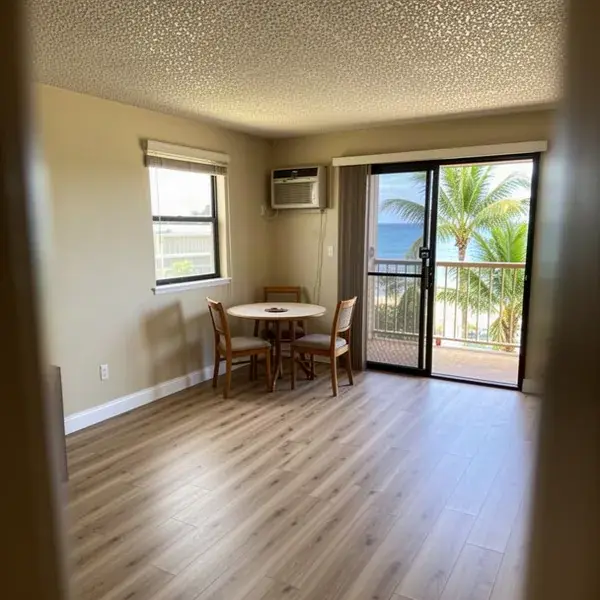
Older concrete buildings, including some beachfront complexes in Kihei and Wailea, may have a ceiling finished directly on the slab below, with no cavity or insulation to help. In those units we lean toward thicker rubber or a glue-down system to make up the difference.
Underlayment Installation Steps
Remove and prep
Half a day to 2 days
The old floor comes out and the slab is scraped, cleaned and checked for flatness. Dips are filled, because a mat cannot bridge them.
Perimeter isolation
1 to 2 hours
A foam isolation strip goes along every wall, column, door frame and cabinet base, so the new floor never touches the structure.
Lay the underlayment
2 to 6 hours
Sheets or rolls are laid with seams butted tight, never overlapped, and taped with the maker’s tape. Bonded mats are rolled into adhesive.
Install the floor
1 to 3 days
The finish floor goes on top following the system that was tested. Tile is set over its membrane with movement joints at the edges.
Trim without bridging
Final day
Baseboards sit just above the floor and the gap is sealed with flexible caulk instead of grout or nails.
Photos and paperwork
Same day
We photograph the underlayment before it is covered, which helps if the association or a neighbor ever asks how it was built.
Slabs that are far out of flat need more than patching, and our subfloor repair and floor leveling team handles grinding and self-leveler before any sound mat goes down.
FAQ
Acoustic Underlayment FAQ
What IIC rating do Maui condos usually require?
Many Maui condo associations ask for IIC 50 or higher for hard floors, and some buildings set their own higher bar of 55 or 60. A few specify a field-tested FIIC instead of a lab number, which is harder to hit.
The only reliable answer is your building's house rules. Our condo flooring service walks you through finding and meeting them.
Can I add underlayment under vinyl plank with an attached pad?
Usually not. Most vinyl plank makers forbid a second cushion under a plank with an attached pad, because the extra softness lets the click joints flex and break, and that voids the warranty. A thin film vapor barrier is often allowed, but check the installation guide.
If the attached pad does not reach your building's number, choose a plank tested with a specific separate underlayment, or a glue-down plank over a rubber mat.
Will underlayment stop all footstep noise?
No. A good system cuts the sharp clicks of heels, dropped items and chair scrapes dramatically, but heavy, low-pitched thuds from walking still travel through the structure. Area rugs, felt pads on furniture legs and an insulated ceiling below all help close the gap.
Floors we install over acoustic underlayment
Where we install acoustic underlayment on Maui
Get a quote
Quiet Your Floors
Send us your building's sound rule, if you have one, and the floor you want. We will check the slab, recommend a tested underlayment system and send a written quote.
- Mon to Sat 7am to 9pm, Sun 9am to 9pm
- 1710 W Kaahumanu Ave, Wailuku, HI 96793
- Licensed, insured and backed by a 1-year labor warranty