Bamboo Flooring Installation on Maui
Maui Prestige Flooring installs strand-woven and engineered bamboo floors in homes, condos and vacation rentals all over Maui. Across 16+ years and more than 1,700 flooring jobs, we have learned that bamboo is only as good as its manufacturing, and the cheapest boxes are usually the ones that gap or cup in island humidity.
Bamboo is a fast-growing grass, sliced, pressed and glued into planks that can be harder than oak. We help you choose a well-made product, acclimate it properly and match the install method to your slab or subfloor.
Every job gets a written quote, moisture readings on the job sheet and a 1-year labor warranty on our installation.
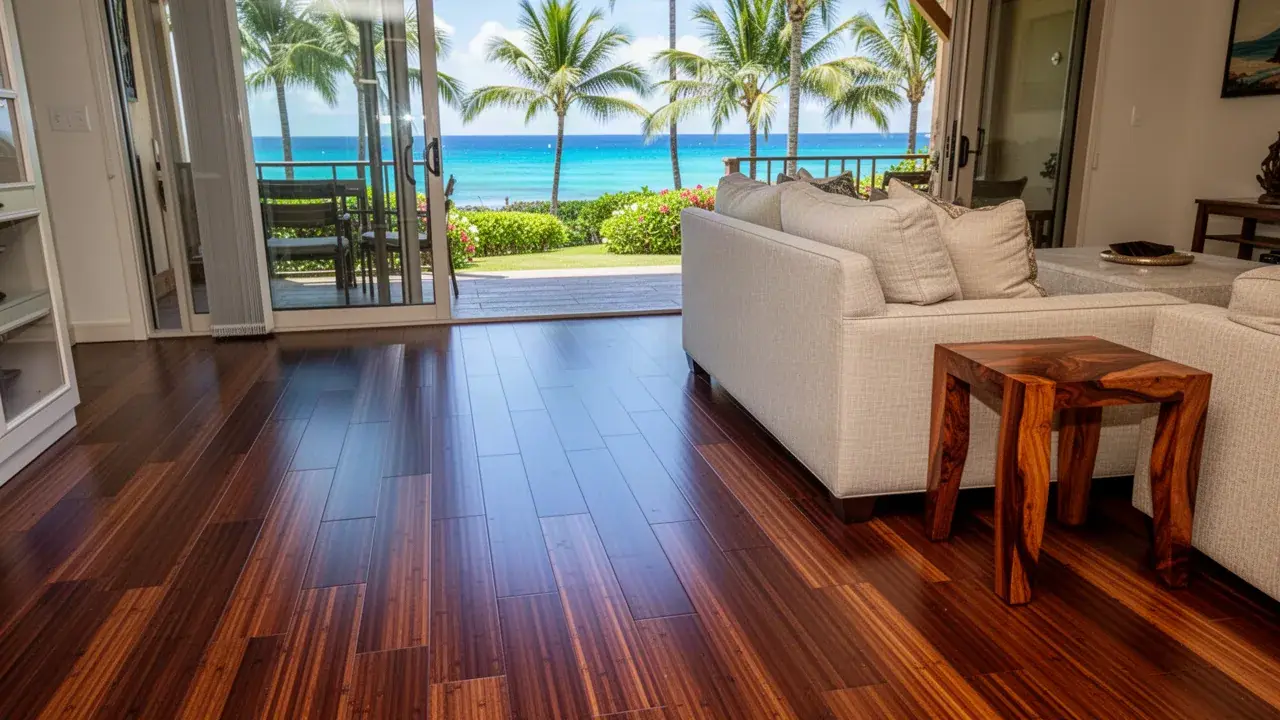
Bamboo Flooring Installation for Maui Homes and Rentals
Bamboo flooring is made from the stalks of Moso bamboo, a giant grass that reaches harvest size in about 5 to 7 years. The stalks are split into strips, dried, and either laminated into planks or shredded and compressed with resin into very dense strand-woven boards.
It suits eco-minded owners who want a natural look, busy households with kids and dogs, and rental owners who need a hard surface that still feels warm. It also gives a wood-like floor at a lower cost than most exotic hardwoods.
Every bamboo flooring installation we quote includes:
- A site visit with moisture readings on the slab or subfloor
- Delivery and acclimation of the bamboo in your home
- Removal of the old floor and any leveling needed
- Floating, glue-down or nail-down installation
- Underlayment, transitions, baseboards or quarter round
- Cleanup and a walkthrough, with spare boards left with you
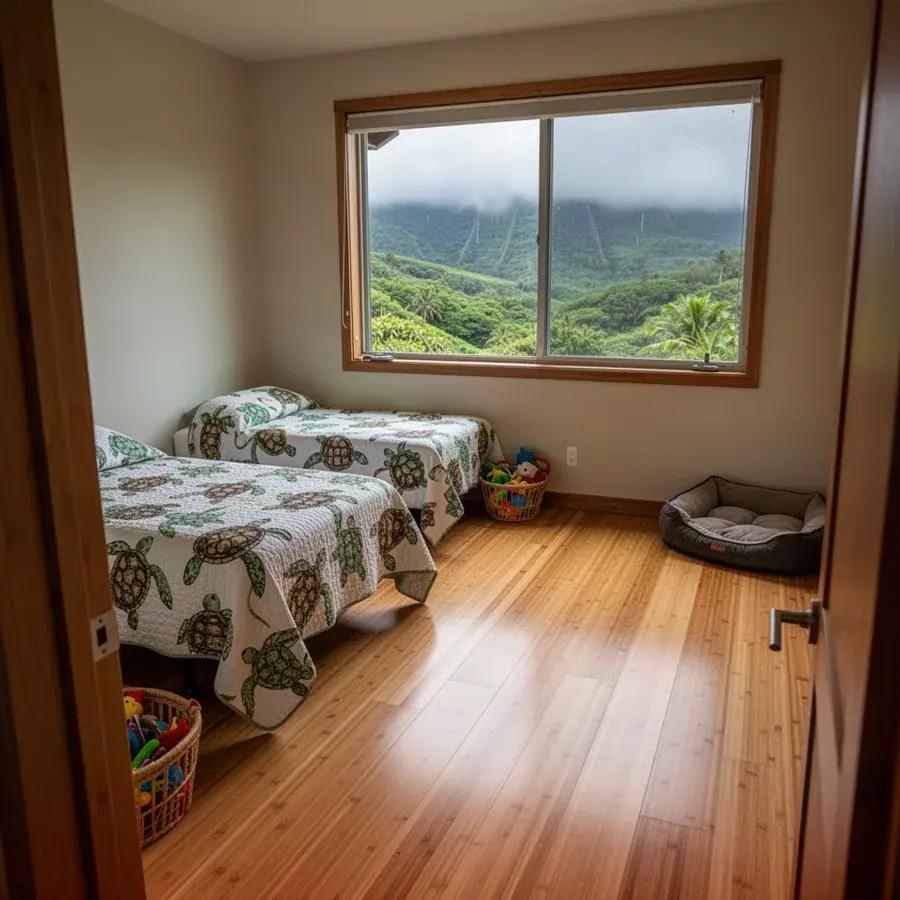
Strand-Woven vs Horizontal and Vertical Bamboo
Strand-woven bamboo is far harder and more dent resistant than horizontal or vertical bamboo, which is why it is our usual pick for Maui homes. Horizontal and vertical planks show the classic bamboo look, with visible knuckles or fine stripes, but they are closer to oak in hardness.
| Factor | Strand-woven | Horizontal | Vertical |
|---|---|---|---|
| How it is made | Shredded fibers compressed with resin | Strips laid flat, knuckles show | Strips stood on edge, fine stripes |
| Janka hardness | Often 3,000 lbf or more | About 1,300 to 1,400 lbf natural | About 1,300 to 1,400 lbf natural |
| Look | Wood-like grain, few knuckles | Classic bamboo with nodes | Uniform, narrow striped look |
| Dent resistance | Excellent, handles pets and luggage | Similar to red oak | Similar to red oak |
| Moisture movement | Stable when well made, poor batches swell | Moderate | Moderate |
| Price | Mid to high for bamboo | Lower | Lower to mid |
For comparison, red oak rates about 1,290 lbf on the Janka scale, which measures the force needed to press a steel ball into the wood. Most bamboo floors on Maui land between about $9 and $16 per square foot installed, with strand-woven at the upper end, and your written quote gives the exact number.
Color is the other choice. Natural bamboo is pale blond, while carbonized bamboo is steamed and heated until its sugars caramelize into a coffee tone all the way through, which softens the fibers and makes carbonized horizontal or vertical planks noticeably easier to dent.
How Bamboo Behaves in Maui Humidity
Bamboo absorbs and releases moisture like wood, so it swells in humid air and shrinks in dry air. Well-made bamboo moves a little and settles, while poorly pressed or overly dry boards can swell, cup or open gaps within months.
Coastal Maui averages roughly 70 to 80 percent relative humidity, often higher on the windward side in Paia and Haiku. Boards dried for a mainland warehouse arrive drier than our air, so they need time to adjust before they are locked together.
That is why we open the boxes in the rooms where the floor will go and check plank and subfloor moisture with a meter until they come within the range the manufacturer specifies. We also leave full expansion gaps at every wall and add T-moldings on very long runs, because bamboo pushes hard when it swells.
Wondering if bamboo will hold up in your home?
We test your slab or subfloor and tell you honestly whether bamboo, engineered wood or vinyl is the better fit.
Bamboo Installation Methods
The right method depends on what is under the floor. Slabs take floating or glue-down bamboo, and raised wood-framed floors take nail-down boards.
Click-Lock Floating Bamboo
Click planks lock together and float over an underlayment, with a 6 mil poly vapor sheet on concrete. It is the fastest method and lets single boards be replaced later.
In condos, the underlayment has to meet the building’s sound rule, which our condo flooring service explains.
Glue-Down on a Concrete Slab
Glued bamboo feels the most solid and sounds the least hollow. We trowel a urethane wood adhesive, from lines such as Bostik or Mapei, straight onto the cleaned slab.
On older slabs without a vapor retarder, we choose a moisture-control adhesive or add a moisture vapor barrier first.
Nail-Down Over Plywood
Raised, wood-framed homes take tongue-and-groove bamboo nailed to the plywood subfloor. Dense strand-woven boards call for thinner 18-gauge cleats, because standard 16-gauge cleats can split the tongues.
We check the framing for termite activity first, a step our hardwood flooring installation page covers in detail.
Is Bamboo an Eco-Friendly Choice?
Bamboo is one of the more renewable floor materials, because the plant regrows from its roots and is ready to harvest in about 5 to 7 years, compared with 40 years or more for many hardwoods. The catch is in the glue and the shipping, so the greenest choice is a well-made product you will not replace early.
Check the adhesive. Engineered bamboo with a plywood or fiberboard core falls under the EPA’s TSCA Title VI formaldehyde limits for composite wood, which mirror California’s CARB Phase 2 standard, so ask for the compliance label or test data.
A FloorScore indoor air quality certification and FSC-certified bamboo are further good signs. On site, we use low-VOC urethane adhesives and waterborne finishes for touch-ups, so the house can be lived in during the job.
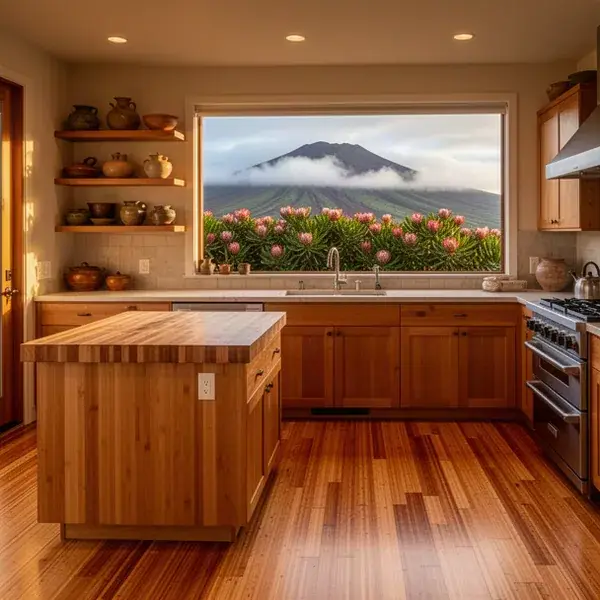
Our Bamboo Installation Process
A typical bamboo floor runs about 1 to 2 weeks from delivery to walkthrough, much of it spent letting the boards settle before they go down. Here is the sequence.
Measure and test
1 visit
We measure every room, take slab or subfloor moisture readings and check flatness, door heights and transitions.
Deliver and acclimate
3 to 7 days
Boxes are opened in the rooms and spaced for airflow. We check plank moisture until it matches the manufacturer’s range.
Prep
1 to 2 days
Old flooring comes out, high spots are ground and low spots filled, and the vapor sheet or barrier goes down.
Install
1 to 3 days
Boards are floated, glued or nailed with expansion gaps at walls, pipes and doorways, and jambs are undercut.
Trim
Final day
Baseboards or quarter round, stair nosing and transitions go on so the gaps are hidden but the floor can still move.
Walkthrough
Final day
We clean up, walk the floor with you, leave spare boards and explain care for sand, grit and spills.
Special-order bamboo colors usually ship from the mainland, so build in about 4 to 6 weeks before the delivery step. If you are still choosing between materials, our engineered hardwood installation and cork flooring installation pages cover two other natural options.
FAQ
Bamboo Flooring FAQ
Can bamboo floors be refinished?
It depends on how the plank is built. Solid strand-woven bamboo can usually be sanded and refinished once or twice, and solid horizontal or vertical bamboo at least once. Engineered bamboo with a thin top layer, and click planks with a hard aluminum oxide factory finish, are often limited to a screen and recoat.
Our hardwood floor sanding and refinishing team checks the top layer before quoting either option.
Does bamboo flooring scratch easily?
Strand-woven bamboo resists dents better than most hardwoods, but the finish on any bamboo floor can scratch. On Maui the main culprit is grit, because beach sand and red dirt tracked in on slippers act like sandpaper.
Walk-off mats at the lanai and front doors, felt pads under furniture and a damp microfiber mop keep it looking new. Horizontal and vertical bamboo, especially carbonized, dents more easily from dropped pans and pet claws.
Is bamboo a good floor for a vacation rental?
It can be, with the right product. A dense strand-woven click plank with a strong factory finish handles guest traffic, and single boards can be replaced. The weak points are wet swimsuits on the floor, units that sit closed and humid between bookings, and warranties that may treat rentals as commercial use.
For a beachfront rental with heavy turnover, rigid core vinyl plank is often the safer pick, and our vacation rental flooring page compares the options.
Get a quote
Choose Your Bamboo Floor
Tell us the rooms, what is on the floor now and whether the home sits on a slab or a raised floor. We will bring bamboo samples, take moisture readings and send a written quote.
- Mon to Sat 7am to 9pm, Sun 9am to 9pm
- 1710 W Kaahumanu Ave, Wailuku, HI 96793
- Licensed, insured and backed by a 1-year labor warranty