Hardwood Flooring Installation on Maui
Maui Prestige Flooring installs real wood floors in Maui homes, condos and businesses, from simple white oak planks to herringbone halls and inlaid medallions. We have spent more than 16 years and over 1,700 jobs learning how wood behaves in island air.
Hardwood can absolutely last on Maui. It just has to be the right construction for your subfloor, acclimated to your home rather than a mainland warehouse, and checked for termites before it goes down.
Whether you live in a raised plantation cottage in Wailuku or a slab-on-grade condo in Wailea, we match the wood, the fastening method and the finish to the building. Every install is backed by our 1-year labor warranty on top of the manufacturer's coverage.
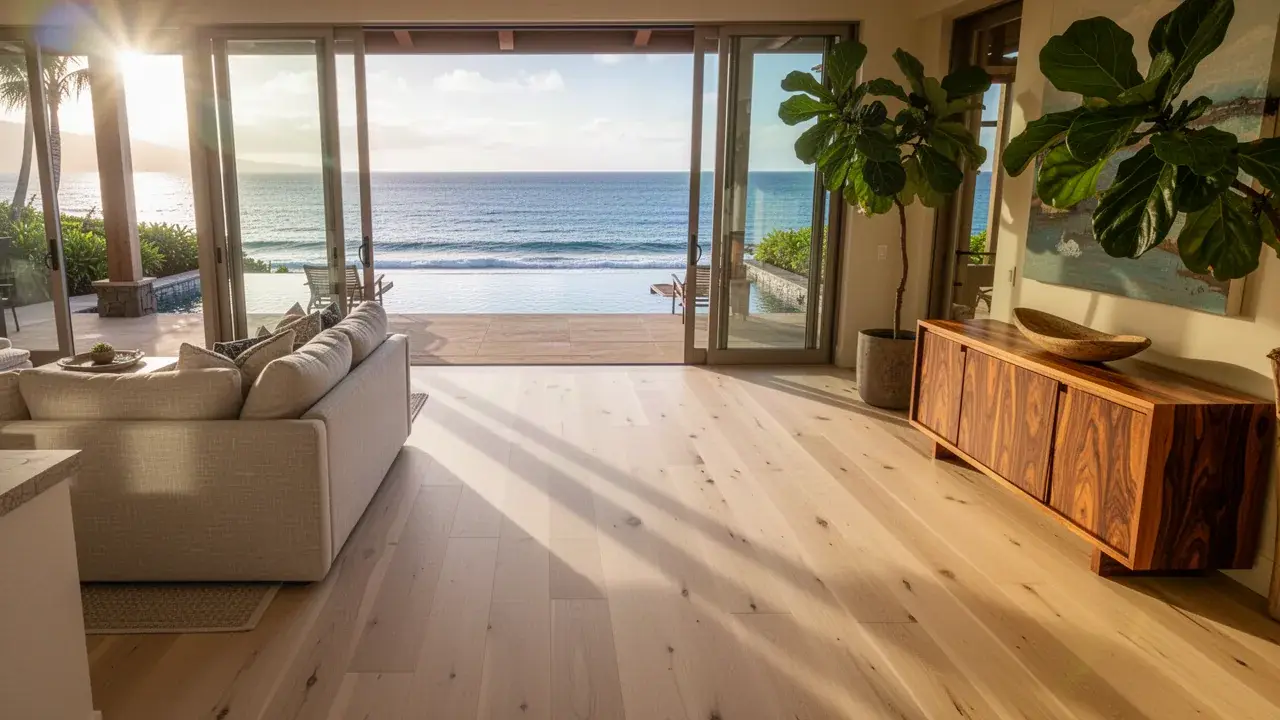
Wood Floors We Install, From Plain Oak to Custom Inlays
We install five kinds of hardwood flooring on Maui, and each one has its own page with the methods, products and decisions involved. The first two are about construction; the last three are about layout.
Every hardwood flooring installation follows the same groundwork whichever style you pick: a termite check, moisture readings on the boards and the subfloor, and a fastening method chosen for the building. Wood flooring that skips any of those steps tends to gap, cup or squeak within a couple of wet seasons.
Solid Hardwood
One piece of wood, usually 3/4 inch thick, nailed to a plywood subfloor. It is the best fit for raised-floor homes and can be sanded and refinished many times over its life.
Engineered Hardwood
A real wood top layer bonded to a stable cross-ply core. It is the usual choice for slab homes and condos, and the only sensible way to get wide planks on concrete.
Herringbone and Chevron
Short boards set in a zigzag, either square-ended herringbone or angle-cut chevron. Layout lines are snapped off the room’s center so the pattern lands evenly at every doorway.
Parquet
Small wood pieces set in geometric blocks such as basketweave or Versailles panels. We install new parquet and match missing blocks in older floors.
Custom Patterns, Borders and Medallions
Contrasting borders, feature strips and inlaid medallions for an entry, dining room or lobby. Each design is drawn to scale before any wood is cut.
Solid or Engineered: Which Works on Your Floor?
On a concrete slab or in a condo, choose engineered hardwood. On a raised floor with a plywood subfloor either works, and solid wood gives you more refinishes over the decades.
| Factor | Solid hardwood | Engineered hardwood |
|---|---|---|
| Construction | One piece of wood, 3/4 inch thick | Wood wear layer over a plywood or HDF core |
| Best subfloor | Plywood over joists | Concrete slab, plywood or existing tile |
| Humidity stability | Moves more; narrower boards advised | Cross-ply core resists cupping and gaps |
| Full refinishes | Typically 4 to 6 or more | 0 to 4, depending on wear layer |
| Install methods | Nail-down, sometimes glue-assisted | Glue-down, floating or nail-down |
| Condo suitability | Rarely, needs a wood subfloor | Common, with approved acoustic underlayment |
| Relative cost | Higher, especially site-finished | Moderate to high |
Wide plank hardwood flooring, anything over about 5 inches, is almost always engineered on Maui. For typical prices, see what flooring installation costs on Maui across every material.
Wood Species That Hold Up in Island Conditions
The species that last best here are hard enough to resist sand and dog claws and stable enough to ride out humidity swings. Hardness is measured on the Janka scale, the force in pounds needed to press a steel ball halfway into the wood.
We bring samples to your home, because a board looks different under Maui sun than in a catalog. Red oak, at about 1,290, is the usual benchmark.
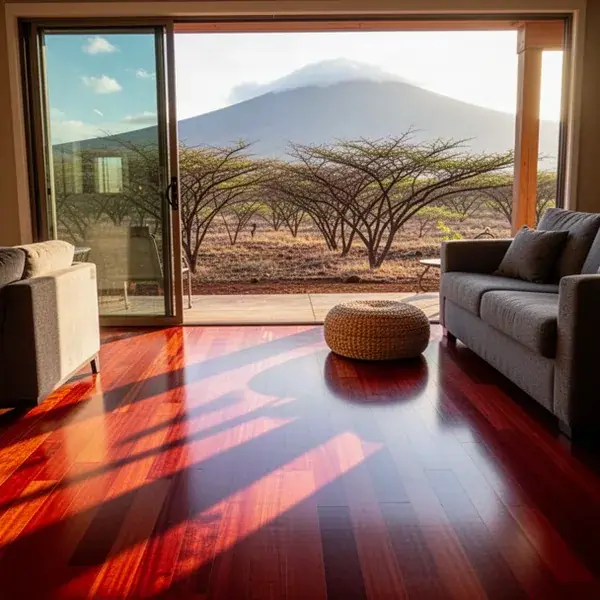
| Species | Janka hardness (approx. lbf) | Color | How it changes in sun |
|---|---|---|---|
| White oak | 1,360 | Pale tan to light brown | Ambers slowly, takes stain evenly |
| Teak | 1,000 to 1,150 | Golden honey | Deepens to warm brown |
| Acacia | 1,700 to 2,200 (varies by species) | Blond to chocolate, high contrast | Darkens and mellows |
| Merbau | 1,800 to 1,900 | Orange brown | Darkens to deep red brown |
| Tigerwood | 1,850 to 2,150 | Orange with dark stripes | Stripes soften, base darkens |
| Cumaru | 3,300 to 3,500 | Tan to reddish brown | Darkens noticeably in the first year |
Published Janka numbers vary a little between test sources, so treat them as guides. Hawaiian koa is a beautiful local option, but supply is limited and the price reflects it.
Humidity, Termites and Sun: Protecting a Wood Floor
Wood on Maui faces three threats that mainland floors rarely meet all at once: steady humidity, two kinds of termites and strong UV through lanai doors. Each one is manageable if it is planned for before the first board is fastened.
Termites. Hawaii has both Formosan subterranean termites, which build mud tubes up from the soil, and drywood termites, which live inside the wood and push out tiny six-sided pellets called frass. Either will eat a hardwood floor and the plywood under it.
Before we install, we inspect accessible joists, subfloor edges and existing boards for mud tubes, frass piles, blistered finish and hollow-sounding spots. If we find activity, we stop and recommend treatment by a licensed pest control company, such as tenting for drywood colonies or soil and bait systems for Formosan termites.
Damaged plywood and joists are replaced before the new floor goes down. Dense species like merbau, teak and cumaru resist termites better than oak, but no wood is immune.
Humidity
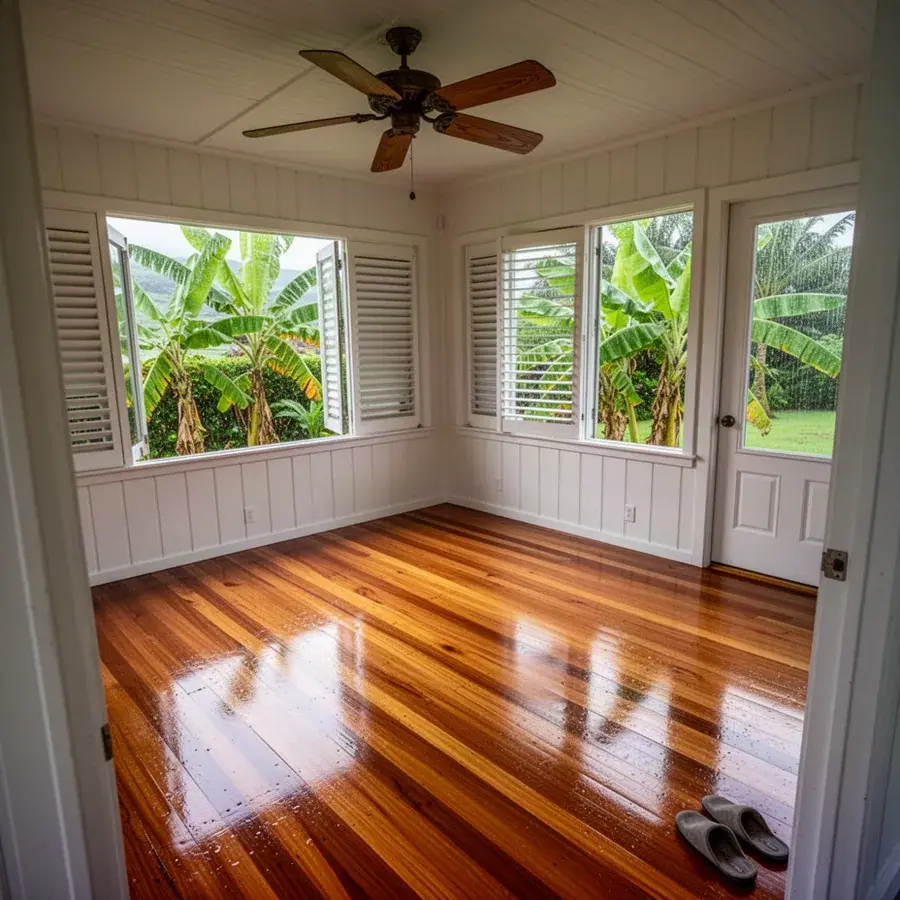
Coastal Maui averages roughly 70 to 80 percent relative humidity, and wood swells and shrinks with it. Our solid hardwood installation process explains how we acclimate boards by moisture reading, not by counting days.
Sun
UV through big sliders fades some species and darkens others within months. Rugs that move seasonally, UV-filtering window film and a finish with UV inhibitors keep the color even from wall to window.
Wondering if wood will work in your home?
We check your subfloor, test for moisture and look for termite signs before recommending a product.
Nail-Down, Glue-Down or Floating
How a wood floor is fastened depends on what is underneath it. Most Maui slab homes get glue-down engineered wood, raised homes get nail-down, and condos often float.
Nail-Down Over a Plywood Subfloor
Boards are blind-nailed through the tongue with a pneumatic flooring nailer into 3/4 inch plywood. It suits raised homes in older Wailuku neighborhoods, Upcountry Maui and the North Shore, and gives the firm, classic feel of traditional hardwood.
Glue-Down on a Concrete Slab
Engineered planks are troweled into a urethane adhesive bonded directly to the slab. It feels solid underfoot, does not sound hollow and handles most Maui homes and ground-floor condos.
Floating Over an Underlayment
Click-together engineered planks rest on a foam or rubber pad without being fastened down. It is the fastest method and pairs well with condo sound rules when the pad carries the rating your building requires.
Already Have Wood Floors? Refinishing and Repair
If your existing wood floor is scratched, gray or worn through the finish, it may not need replacing at all. Our hardwood floor sanding and refinishing service can bring solid and thick-wear-layer engineered floors back to bare wood and new color.
Cupped boards, pet stains, termite damage or a few broken planks are a job for our hardwood floor repair team, who weave in matching boards so the patch disappears. When a leak or flood is behind the damage, the water and flood damaged floor repair page explains drying and insurance documentation.
FAQ
Hardwood Questions From Maui Homeowners
Is hardwood a good idea in Hawaii's humidity?
Yes, as long as three things are right: the product, the acclimation and the moisture control. Engineered wood on slabs, solid wood only over dry plywood, boards brought to the moisture level of your home before install, and air conditioning or dehumidifiers that keep indoor humidity steady.
Where those are not possible, such as a beach rental left closed up for weeks, we will tell you honestly that vinyl plank or tile is the safer floor.
How wide can hardwood planks go on a slab?
Engineered planks of 7 to 9 inches and even wider are common on Maui slabs because the cross-ply core resists cupping. The wider the board, the flatter the slab has to be, so wide plank jobs usually need more grinding and leveling.
Solid wood is a different story. We generally keep solid boards at 5 inches or narrower in our climate, and never put solid wood directly on concrete.
Services that pair with a new wood floor
Get a quote
Talk Wood Floors With a Maui Installer
Send us your rooms, your subfloor type if you know it and a photo of the look you like. We will bring samples, take moisture readings and write up a hardwood quote you can compare line by line.
- Mon to Sat 7am to 9pm, Sun 9am to 9pm
- 1710 W Kaahumanu Ave, Wailuku, HI 96793
- Licensed, insured and backed by a 1-year labor warranty